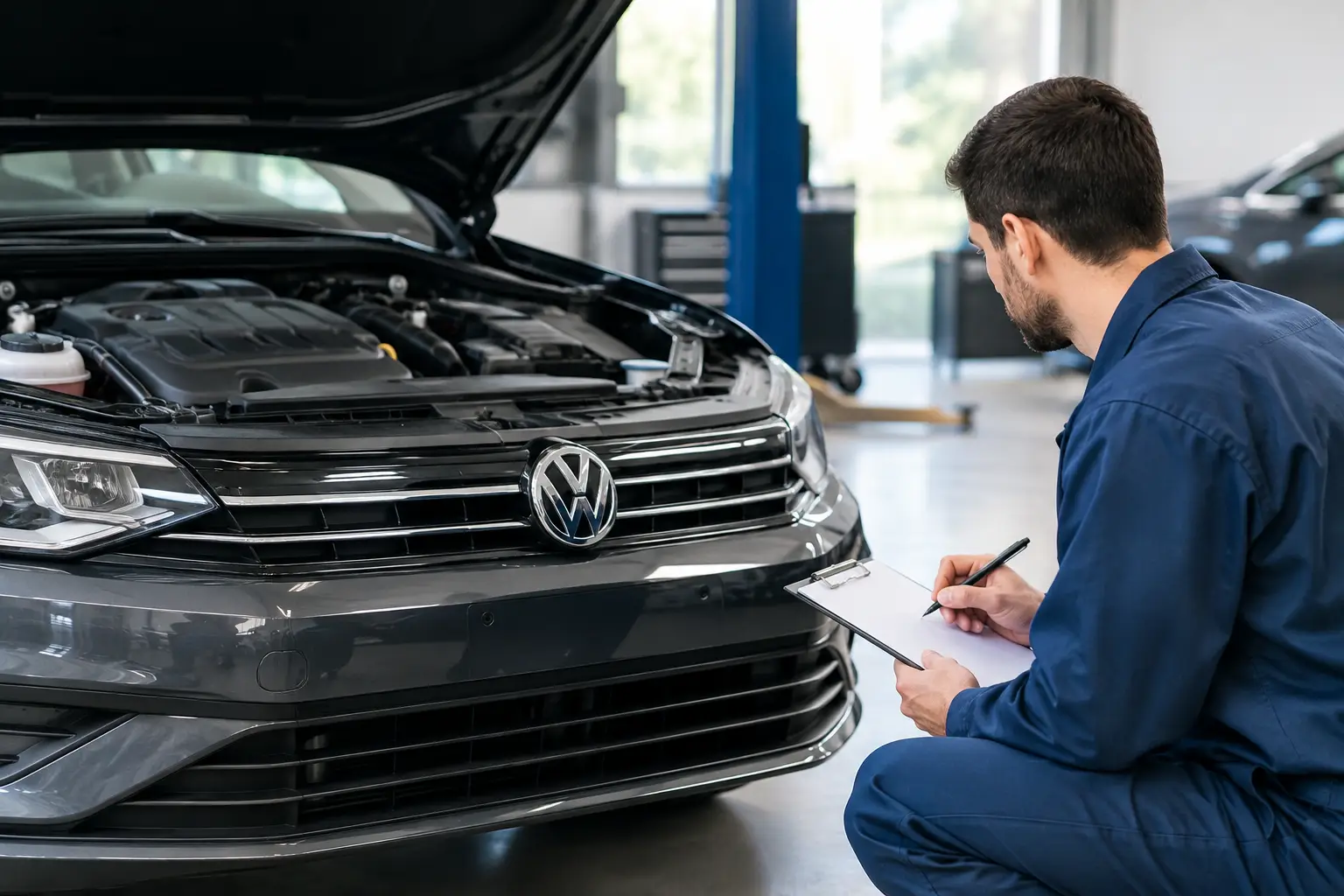

Nothing is more frustrating than booking an MOT, rearranging your day, then finding the car failed on something small you could have spotted on the drive. If you are wondering how to prepare car for MOT, the good news is that a few sensible checks beforehand can reduce the risk of an avoidable failure and save time, money and hassle.
For most drivers, MOT preparation is not about second-guessing the tester. It is about making sure the obvious items are in order before the car goes into the workshop. That matters even more if you rely on your Audi, Volkswagen, Škoda or SEAT for commuting around Aldermaston, school runs in Tadley, or regular trips into Reading, Basingstoke or Newbury. A failed MOT can be inconvenient enough. A failure that could have been prevented is worse.
How to prepare car for MOT without guessing
The best approach is simple. Start with the items you can check yourself safely, then deal with anything doubtful before test day. You do not need specialist tools to notice a blown bulb, worn tyre or ineffective wiper blade. You do need to be realistic though. If a brake warning light is on, the steering feels wrong, or the engine management light keeps appearing, that is no longer a driveway check. It needs proper diagnosis.
An MOT is a roadworthiness test, not a full service, so a car can pass and still need maintenance. The reverse is also true. A well-serviced car can still fail on something straightforward if it has been overlooked. That is why preparation works best when it covers both the basic visible items and any known faults you have been putting off.
Lights, indicators and warning lamps
Start with the lights because they are one of the easiest causes of failure to prevent. Check sidelights, dipped beam, main beam, brake lights, number plate lights, indicators, repeaters, reverse lights and rear fog lights. If you can, ask someone to help while you operate the controls. If not, reflections in windows or garage doors can help.
Inside the car, pay attention to dashboard warning lamps. The ABS, airbag, engine management and other safety-related lights should illuminate correctly and then go out if the system is functioning as it should. A light that stays on is a warning, not a suggestion. On modern VAG vehicles especially, fault codes can point to issues that are not always obvious without diagnostic equipment.
Tyres, wheels and tread depth
Tyres are another common issue. The legal minimum tread depth is 1.6mm across the central three-quarters of the tyre, but waiting until they are right on the limit is poor planning. Grip in wet conditions drops off well before that point, and if the wear is uneven it can suggest alignment or suspension problems.
Check all four tyres for cuts, bulges, cracking and exposed cords. Do not forget the inner edges, which are easy to miss. Also check that the tyre sizes match appropriately across each axle and that the pressures are sensible. Incorrect tyre pressure will not necessarily cause a failure on its own, but it can affect handling, braking and wear.
Wipers, washers and the windscreen
If the wipers smear, judder or leave gaps, replace them before the test. This is one of the cheapest fixes you can make, and it improves visibility straight away. Make sure there is enough screenwash in the bottle and that the washers actually spray properly.
Look closely at the windscreen too. Chips and cracks are judged partly by size and partly by where they are. Damage in the driver’s line of sight is taken more seriously than damage elsewhere. If you are unsure whether a chip is acceptable, it is worth having it assessed rather than hoping for the best.
The checks many drivers forget before an MOT
Some MOT failures come from items drivers rarely think about until the test is due. Number plates need to be secure, readable and correctly spaced. If they are cracked, badly faded or obscured by dirt, clean or replace them.
Seatbelts should pull out smoothly, latch securely and retract properly. Give each one a quick check. Doors must open from the correct side, and the boot should latch as it should. The horn also needs to work. None of these checks takes long, but they are easy to miss if you are rushing.
Cleanliness matters more than some people expect. A very dirty car will not automatically fail, but if mud hides a registration plate or clutter inside the car prevents proper inspection, you are creating unnecessary problems. If the tester cannot access something safely, that can slow the process down or lead to a refusal to test.
Brakes, suspension and steering
This is where honesty matters. You can do a basic sense-check, but you cannot fully assess braking performance or suspension condition on the driveway. If the car pulls under braking, knocks over bumps, vibrates through the steering wheel, or feels unstable at speed, get it looked at before the MOT.
Likewise, if you have noticed grinding brakes, excessive tyre wear, clunks from the front end or a steering wheel that sits off-centre, those are signs to act on. With Audi, Volkswagen, Škoda and SEAT models, worn suspension arms, bushes, links and bearings are not unusual as mileage climbs. Left alone, they can become MOT failures and affect how the car drives day to day.
Exhaust, emissions and engine faults
A loud exhaust, visible smoke or an engine that does not run cleanly can all lead to trouble on test day. Emissions failures are especially common when an engine has underlying faults that have not been diagnosed properly. Misfires, intake leaks, failing sensors and DPF or EGR issues can all contribute.
This is where MOT preparation overlaps with proper fault-finding. Clearing a warning light without fixing the cause is not preparation. It is delay. If your car has been hesitant, using more fuel than normal, or showing intermittent warning lights, get it checked before the test rather than after a fail sheet lands in your hand.
Should you service the car before the MOT?
Sometimes yes, sometimes no. If the service is due around the same time, it often makes sense to combine them. A service can pick up worn components, fluid issues and maintenance items before they become MOT failures. It is also more efficient than making separate bookings.
That said, a service is not a guarantee of an MOT pass, because the two inspections are different. MOT testing follows a set standard, while servicing is broader maintenance. If your car has known faults, unusual noises or warning lights, the smartest route is usually an inspection or diagnostic check before the MOT, not just a routine oil service.
For local drivers around Aldermaston, Tadley, Basingstoke, Reading and Newbury, that can make life a lot easier. If the workshop identifies issues in advance, you have more control over timing and repair decisions rather than reacting to a failure on the day.
How to prepare car for MOT if you drive a VAG vehicle
If you own an Audi, VW, Škoda or SEAT, some faults are better handled by a workshop that knows the platforms well. Electronic parking brake faults, ABS sensor problems, engine management issues, suspension wear and DSG-related warning messages are not unusual on higher-mileage cars, and generic checks do not always tell the full story.
That does not mean every VAG car needs specialist work before an MOT. It means that when something does not feel right, experience matters. A workshop with the right diagnostic equipment and brand knowledge can often pinpoint faults faster and avoid unnecessary parts swapping. That is particularly useful if your car is your daily transport and you cannot afford repeated visits.
When to book MOT preparation rather than doing it yourself
DIY checks are worthwhile, but they have limits. If your car is older, has a recent advisory history, or has any warning lights, noises or handling concerns, booking a pre-MOT inspection is usually the more sensible option. It gives you a clearer picture of what is likely to pass, what may fail, and what is worth dealing with now.
That is often the practical choice for busy drivers in this part of Berkshire and north Hampshire. If you are working in Reading, based near Basingstoke, or managing family life around Tadley and Aldermaston, losing the car unexpectedly is disruptive. A proper MOT prep check helps reduce that risk.
A good workshop will also be straightforward about the difference between essential repairs and items worth monitoring. That matters, because not every advisory needs immediate replacement, and not every small issue should be ignored. The right advice sits in the middle – safe, sensible and proportionate.
If you want the best chance of a first-time pass, prepare early rather than the night before. Check the basics yourself, take warning signs seriously, and if anything feels questionable, get it looked at properly. A little preparation usually costs less than a failed test, and it makes driving away with a fresh MOT a far less stressful part of the week.
Need help with your Audi, VW, Škoda, SEAT or Cupra? Mechalex is an independent VAG specialist in Aldermaston, serving Reading, Newbury, Basingstoke and Tadley.
See our servicing & MOT service, try our free VAG AI diagnosis, or book online. Call 0118 380 1003.