A £20 saving on a part can be good value, or it can create a second repair bill a few months later. That is why the question of OEM parts versus equivalent parts matters when your Audi, Volkswagen, Škoda or SEAT is booked in for work. The right answer is not automatically “buy the most expensive part”. It is choosing a component that suits the repair, the vehicle’s condition and how you use it.
For VAG owners, parts choice is particularly relevant. These vehicles often rely on closely matched electronic systems, precise tolerances and model-specific service procedures. A good independent specialist should be able to explain what is being fitted, why it is appropriate and what it means for cost and reliability.
What are OEM parts?
OEM stands for Original Equipment Manufacturer. In everyday workshop terms, an OEM part is made to the same specification as the component originally fitted to the vehicle, often by the manufacturer that supplied the production line.
There is a useful distinction to make. A genuine VAG part is supplied in Audi, Volkswagen, Škoda or SEAT packaging through the manufacturer’s parts network. An OEM part may be made by the same supplier, to the same standard, but sold under that supplier’s own brand. Depending on the component, the difference may be packaging, availability and price rather than the item’s underlying quality.
For certain repairs, OEM or genuine parts are often the sensible choice. This can include electronic modules, sensors where calibration matters, timing components, specialist fluids and parts that are known to affect drivability or fault codes if their specification is wrong. On a DSG or Haldex service, for example, using the correct approved fluid, filter and seals is not an area for guesswork.
What are equivalent parts?
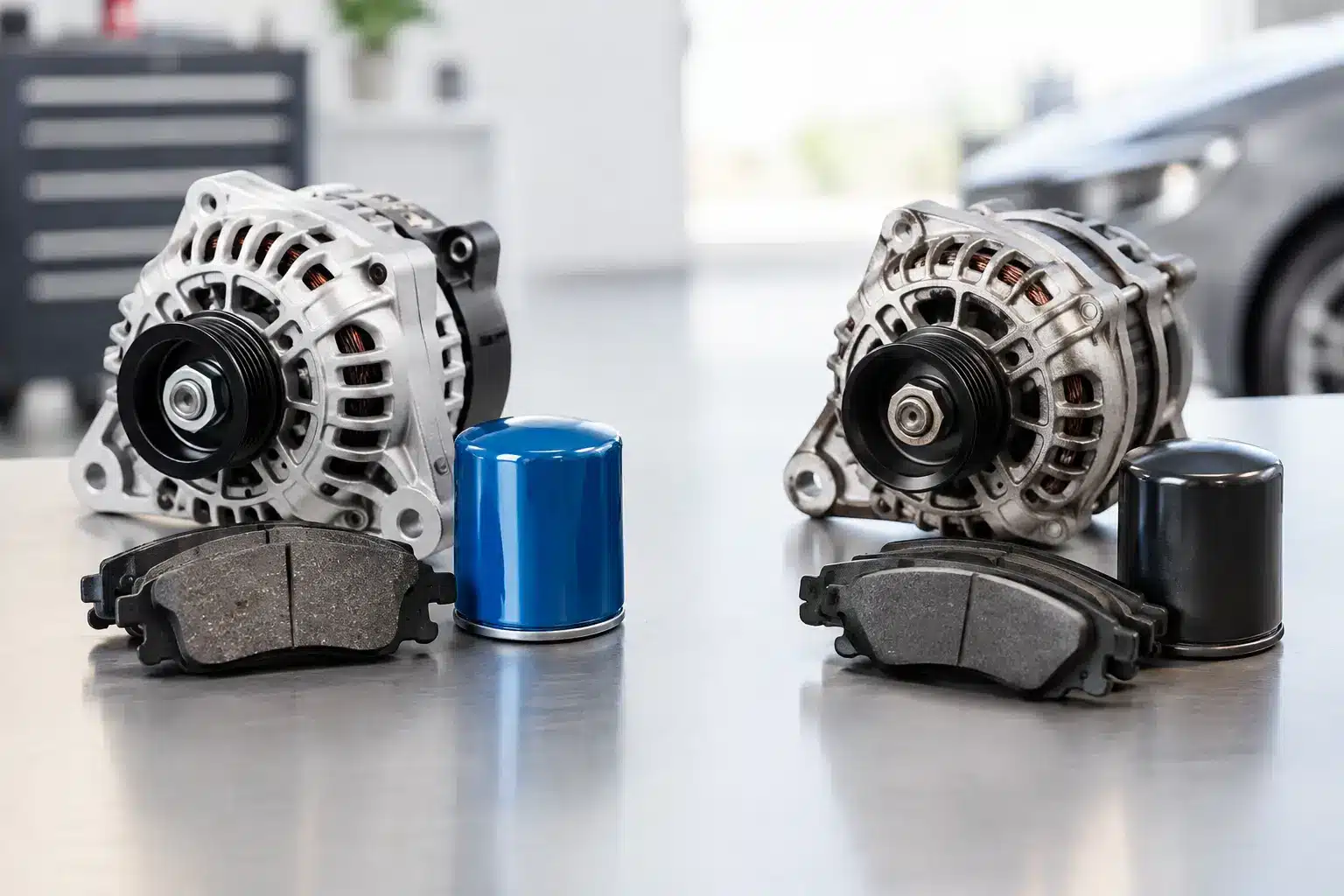
An equivalent part is an aftermarket component designed to match the fit, function and performance of the original. The word “equivalent” does not mean every aftermarket part is identical, and that is where care is needed.
Some equivalent parts are excellent. Reputable manufacturers produce brake discs, pads, filters, suspension parts, clutches and service items that meet or exceed the requirements of many daily-driven VAG cars. They can offer dependable performance at a more sensible price point.
Others may look similar on the shelf but use different materials, less precise manufacturing or weaker quality control. A cheap sensor, water pump or suspension bush can fit initially yet fail early, cause warning lights or affect how the car drives. The part price is only one part of the job. Labour, diagnostic time and disruption all cost more if the vehicle has to return.
Equivalent does not mean “the cheapest available”
A quality equivalent part should come from a recognised supplier and be selected for the specific vehicle and repair. It should not be a vague promise that a part will “probably fit”. Correct part matching means checking the registration, VIN information, engine code and, where relevant, PR codes or gearbox details.
This is especially important across the VAG range. Two cars that appear identical can have different brake systems, engine variants, drivetrain components or software requirements. The correct part is the one that matches the car in front of the technician, not simply the model badge.
OEM parts versus equivalent parts: where each makes sense
The best choice depends on the consequences of failure, how difficult the part is to replace and whether the component interacts with complex VAG systems.
For routine servicing, a premium equivalent oil filter, air filter, pollen filter or brake component can often be a very good choice. Provided it meets the required specification, it can deliver reliable results and help keep maintenance affordable. That matters for families, commuters and business drivers who need their car kept on the road without paying main dealer rates.
For major service work, the decision deserves more thought. A cambelt and water pump replacement involves considerable labour, so fitting a proven kit from an approved or established supplier makes sense. Saving a small amount on a low-quality tensioner or pump is false economy when access is difficult and a failure can cause major engine damage.
With diagnostics and electronic repairs, compatibility is often the deciding factor. Mechatronic faults, DSG issues, engine management concerns and four-wheel-drive systems may require genuine, OEM or carefully selected specialist components, followed by coding, adaptation or calibration. The part alone is not the repair. Correct diagnosis and setup are just as important.
Safety-critical components deserve the same sensible approach. Brakes, steering, tyres and suspension should never be chosen on price alone. A reputable equivalent can be entirely appropriate, but the specification must suit the vehicle, its load rating and the way it is driven. An enthusiast’s tuned Golf R may need a different brake solution from a family Škoda used for school runs and motorway miles.
Will equivalent parts affect my warranty?
This depends on the vehicle, its warranty terms and the work being carried out. If your car is still covered by a manufacturer or third-party warranty, ask before authorising repairs. Keep clear invoices showing the work completed, the specification of fluids used and the parts fitted.
For servicing, following the correct schedule and using parts and lubricants that meet the required specification is crucial. For a newer Audi, Volkswagen, Škoda or SEAT, the workshop should be able to confirm the relevant oil standard and service requirements rather than relying on a generic product.
If a warranty provider requires a genuine part for a particular repair, that should be discussed upfront. A professional workshop will explain the options clearly instead of fitting an alternative without your approval.
How a VAG specialist chooses the right part
A proper recommendation starts with diagnosis, not a parts catalogue. Fault codes are useful, but they are not a diagnosis on their own. A VAG-trained technician will consider live data, wiring, known platform issues, service history and physical inspection before deciding whether a component has actually failed.
This process protects you from unnecessary spending. A warning light that appears to point to a sensor may be caused by a wiring fault, air leak, weak battery or a separate mechanical issue. Replacing the named part without testing can leave you with the same problem and a lighter wallet.
Once the fault is confirmed, the choice should be practical. Consider the age and value of the car, planned ownership, mileage, type of driving and repair risk. An older SEAT Ibiza might be best served by a trusted equivalent component. A low-mileage Audi with a complex transmission concern may justify an OEM-focused solution.
At Mechalex, the aim is to give VAG owners a clear recommendation based on the job, not a one-size-fits-all rule. With more than 30 years of experience and modern diagnostic equipment, the priority is a repair that works properly and remains dependable.
Local VAG servicing without the main dealer cost
For drivers in Aldermaston, Tadley, Basingstoke, Reading and Newbury, an independent VAG specialist can offer the technical focus of a dealer-level workshop with a more personal conversation about costs and options. That is useful when you are arranging a DSG service, cambelt replacement, Haldex service, diagnostic repair or routine maintenance around work and family commitments.
If you are asking where to get an Audi DSG service, look for more than a low headline price. The workshop should use the correct fluid and filter specification, understand the service interval for your gearbox, check for related faults and carry out any required adaptations. The same principle applies to Volkswagen, Škoda and SEAT models with DSG transmissions.
Before work starts, ask which parts are being proposed and why. A trustworthy answer should be straightforward: genuine or OEM where the repair demands it, quality equivalent parts where they offer sound value, and no compromises on fit, safety or specification.
The useful question is not “Are OEM parts always better?” It is “What is the right-quality part for this job, on this car, and why?” A workshop that can answer that clearly is helping you spend wisely, not simply spend more.
Need help with your Audi, VW, Škoda, SEAT or Cupra? Mechalex is an independent VAG specialist in Aldermaston, serving Reading, Newbury, Basingstoke and Tadley.
See our servicing & repairs service, try our free VAG AI diagnosis, or book online. Call 0118 380 1003.