You usually notice it gradually. The throttle response feels softer than it used to, idle can be slightly uneven, and the car that once felt sharp through the mid-range now seems a bit flat. When people ask about walnut blasting before after results, that is normally what they want to know – does it actually make a difference you can feel, or is it just another workshop buzzword?
On many direct injection petrol engines, especially across the Volkswagen Audi Group range, carbon build-up on the intake valves is a real and well-known issue. Because fuel is injected directly into the combustion chamber rather than washing over the intake valves, oily vapours and residues can stick and bake onto the valve surfaces over time. The result is restricted airflow, poorer combustion quality and a gradual loss of the smooth, eager performance the engine should have.
What walnut blasting before after results usually look like
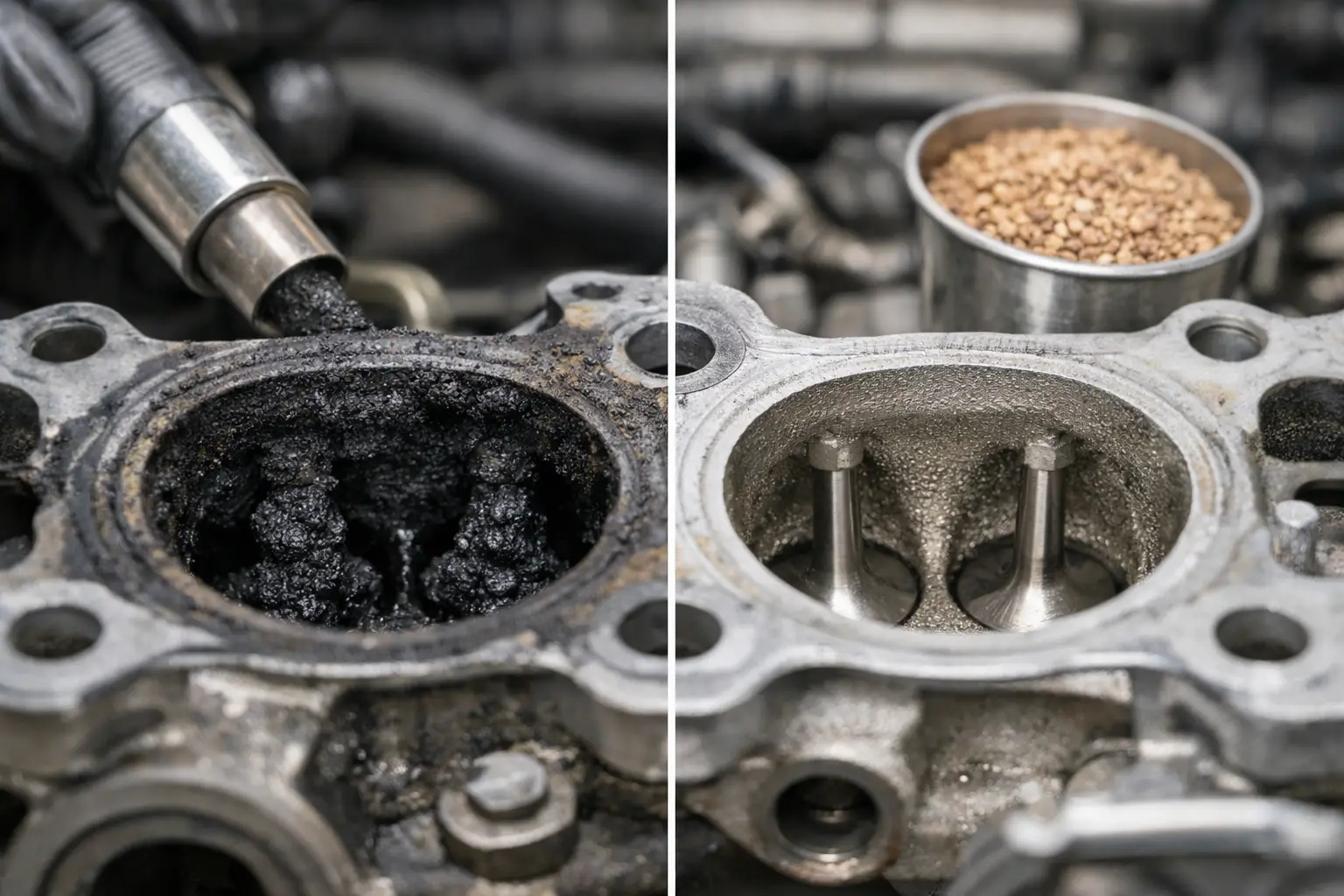
The most obvious before-and-after difference is visual. Before cleaning, intake valves can be heavily coated in thick, black carbon deposits. In worse cases, the build-up is so substantial that the valve shape is partly obscured. After walnut blasting, those same valves are returned much closer to clean bare metal, allowing air to flow as intended.
That visual improvement matters because it often translates into real-world changes from the driver’s seat. Many owners report better idle quality, cleaner pick-up from low revs, improved throttle response and more consistent performance through the rev range. On engines that have been suffering quite badly, the change can be very noticeable. On others, especially if the carbon build-up is moderate rather than severe, the improvement may be more subtle but still worthwhile.
The honest answer is that it depends on the condition of the engine before the work is done. If the valves are heavily coked up, the difference can feel significant. If the deposits are only starting to build, walnut blasting may restore lost sharpness rather than create a dramatic transformation.
Why carbon build-up affects VAG petrol engines
This is most commonly discussed on turbocharged direct injection petrol engines, where intake valve deposits build over time as part of normal operation. Driving style can influence how quickly it happens. Cars used mainly for short trips, cold starts and stop-start traffic often build contamination faster than those regularly driven on longer runs.
PCV system behaviour, oil vapour recirculation and general engine condition also play a part. It is not always a sign that something is badly wrong. In many cases, it is simply one of those maintenance realities of modern direct injection design.
For Audi, Volkswagen, Škoda and SEAT owners, this is one of those jobs where brand-specific experience helps. The symptom pattern is familiar, and so are the engines affected. That means the process is less about guesswork and more about confirming whether carbon build-up is genuinely the cause of the complaint.
The symptoms owners notice before cleaning
Most people do not book carbon cleaning because they have seen the valves themselves. They book it because the car no longer feels quite right.
A rougher idle is a common starting point. Some cars also show hesitation under light acceleration, reduced fuel efficiency or a general sense that the engine is not breathing as freely as it should. Enthusiast drivers often notice a drop in crispness first, while daily drivers are more likely to describe the car as sluggish or less refined.
In some cases, there may also be misfire faults or running issues, but this is where proper diagnosis matters. Carbon on the valves can absolutely cause driveability problems, but it is not the only possible reason. Ignition issues, vacuum leaks, injector faults and sensor-related problems can produce similar symptoms. Walnut blasting is effective when carbon build-up is the problem. It is not a cure-all for every petrol engine fault.
What happens during walnut blasting
Walnut blasting is a controlled carbon-cleaning process used to remove deposits from the intake valves and ports. Crushed walnut shell media is blasted onto the carbon build-up, breaking it away without damaging the metal surfaces when carried out correctly.
The intake system has to be stripped to gain access, and each valve set is cleaned carefully with the engine positioned correctly. This is not a pour-in additive and it is not a quick cosmetic treatment. Done properly, it is a workshop job that takes time, attention and the right equipment.
That is one reason the results are generally far better than fuel additives or off-the-shelf induction cleaners on engines with serious valve contamination. If the carbon is physically stuck to the intake valves, the most effective fix is usually physical removal.
Walnut blasting before after results you can actually feel
Drivers often focus on peak power figures, but the everyday gains are usually more useful. A cleaned intake path can help the engine return to the way it was designed to deliver air, which tends to improve responsiveness rather than create some unrealistic performance leap.
After cleaning, the engine may idle more steadily and rev more cleanly. The throttle can feel more precise, especially at low and medium engine speeds. Pulling away may become smoother, and acceleration can feel more linear. On turbo petrol engines, restoring airflow can also help the car feel more willing through the middle of the rev range, where many owners notice lost performance first.
If you use your car every day, that matters more than headline numbers. A car that starts cleanly, drives smoothly in traffic and responds properly when joining a dual carriageway is simply nicer to live with.
What walnut blasting will not fix
This part is just as important as the positives. Walnut blasting does not repair worn components, faulty ignition parts, injector problems, boost leaks or timing-related issues. If an engine has several faults at once, cleaning the valves may improve one area while leaving other symptoms behind.
It also will not permanently stop carbon from returning. Direct injection engines can build deposits again over time. The goal is to restore performance and drivability, not to pretend the issue can never come back.
That is why the best workshops do not oversell the job. If the engine needs diagnostics first, that should come first. If walnut blasting is the right answer, it should be recommended for a clear reason.
When is walnut blasting worth it?
It is usually worth considering when a direct injection petrol engine has covered enough miles for deposits to build and there are symptoms that point towards restricted intake flow. It also makes sense for owners who want to restore lost performance before further tuning work, because there is little value in calibrating around an engine that is not breathing properly.
For some cars, walnut blasting is partly corrective. For others, it is preventative maintenance done at sensible intervals to keep the engine performing as it should. There is no perfect one-size-fits-all mileage because usage, engine type and condition vary, but if your VAG petrol engine feels less responsive than it used to, it is a conversation worth having.
This is especially relevant in the wider Aldermaston, Tadley, Basingstoke, Reading and Newbury area, where many owners rely on their car for commuting as much as enjoyment. If the car is used daily, drivability and reliability matter just as much as outright performance.
Why specialist experience matters
On paper, walnut blasting sounds straightforward: remove carbon and reassemble. In reality, the quality of the result depends on correct diagnosis, proper access, careful cleaning and checking the engine condition as a whole.
That is where a VAG specialist has an advantage. Familiarity with common intake designs, known engine behaviours and platform-specific faults helps ensure the job is done for the right reasons and to the right standard. If there are other issues affecting performance, they should be identified rather than hidden behind a carbon-cleaning invoice.
At Mechalex, that approach matters. Customers generally are not looking for workshop theatre. They want an honest assessment, dealer-level technical ability and work carried out properly without main dealer pricing.
Is the before-and-after difference worth the cost?
For the right car, yes. If carbon build-up is clearly affecting how the engine runs, walnut blasting can be one of the more satisfying maintenance jobs because the results are tied to a real mechanical problem. You are not paying for a vague promise. You are restoring airflow and combustion conditions that have deteriorated over time.
The value is highest when the symptoms fit, the diagnosis is sound and the engine is otherwise healthy. If those pieces line up, the before-and-after results are often easy to justify. If they do not, a good workshop should say so.
There is also a wider point here. Cars rarely become disappointing overnight. They drift away from their best bit by bit, and owners get used to the decline. Then a proper fix reminds you how the car was meant to feel. That is often the real appeal of walnut blasting – not chasing miracles, just getting your engine back to doing its job properly.