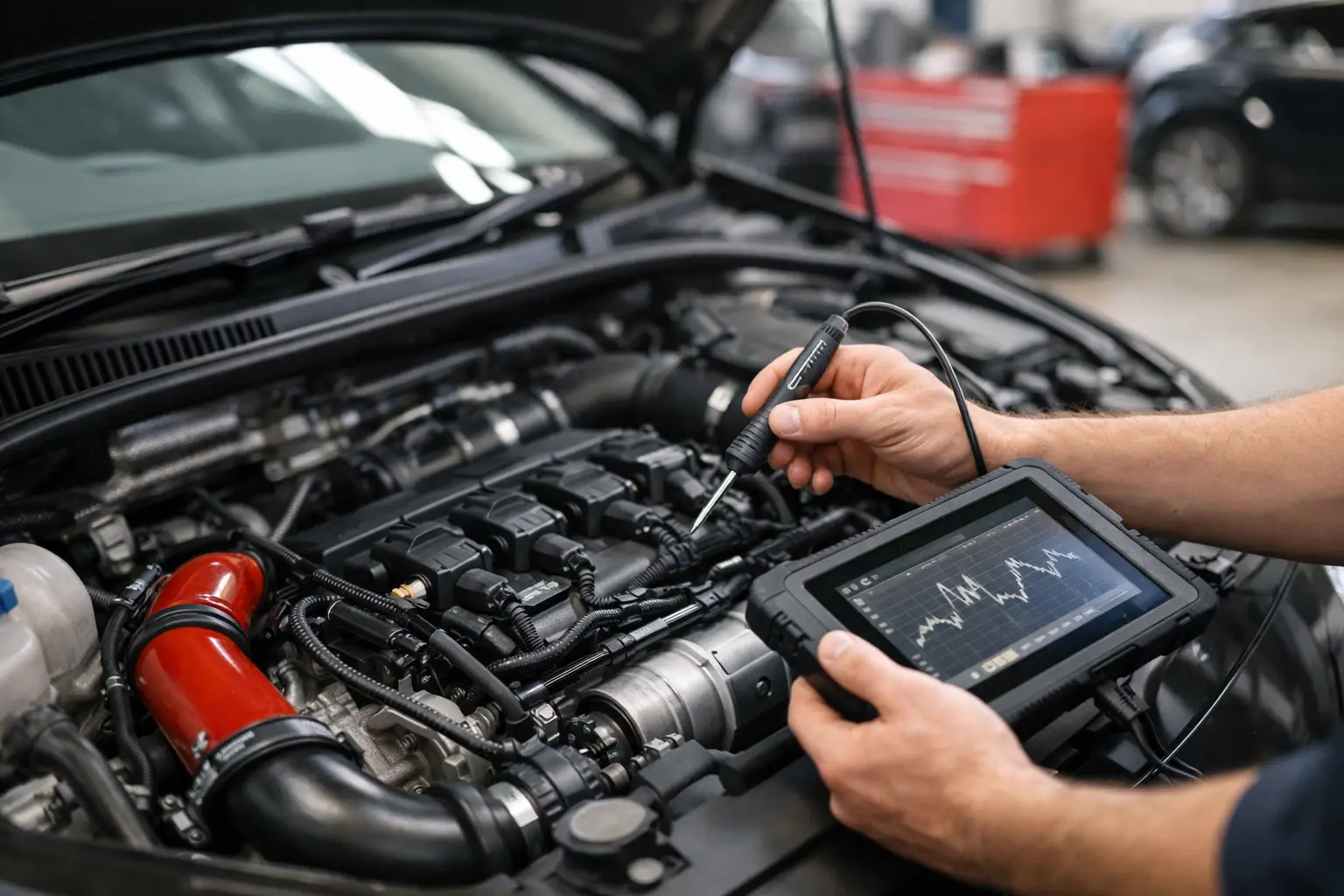
That awkward moment when the engine light flashes, the car stumbles for a few seconds, then drives normally again is exactly what makes TSI misfires so frustrating. By the time the car gets to a workshop, it may idle cleanly, rev freely and refuse to misbehave. That does not mean the fault has gone away. It usually means the fault needs to be caught properly.
On Volkswagen Audi Group petrol models, diagnosing intermittent misfire on TSI engines is rarely about guessing and swapping parts until the symptom disappears. These engines can misfire for several different reasons, and the pattern matters. A cold-start misfire points you in a different direction from a full-load misfire, and a random cylinder fault needs a different approach from a repeated misfire on cylinder 2.
Diagnosing intermittent misfire on TSI starts with the pattern
The first job is to understand when the misfire happens. If it only occurs from cold and smooths out within a minute, that often suggests carbon build-up, injector issues or a fuelling imbalance. If it appears under load, especially in higher gears, ignition breakdown or boost-related faults move much higher up the list. If it happens at idle once the engine is hot, vacuum leaks, injector performance or compression issues become more relevant.
This is why a proper diagnostic process matters more than a fault code reader alone. A stored misfire code such as P0300, P0301, P0302, P0303 or P0304 is only the starting point. The useful information is in the freeze-frame data, the live misfire counters, fuel trims, load values and temperature conditions when the fault was recorded.
On VAG vehicles, manufacturer-level diagnostics can show a lot more than a generic scan tool. You can often see whether one cylinder is consistently the problem, whether the issue only appears in a certain operating range, and whether the engine control unit is compensating for a lean or rich condition.
The usual TSI misfire suspects
Ignition components are still one of the most common causes. Coil packs on TSI engines can fail intermittently rather than outright, which is why the car may run perfectly during a quick inspection. Spark plugs can also be a factor, especially if the wrong type has been fitted, the gap is excessive, or service intervals have been stretched too far. On tuned cars, this matters even more because a plug that just about copes on a standard engine may break down under higher cylinder pressures.
That said, not every TSI misfire is a coil or plug. Direct injection engines are well known for carbon accumulation on the intake valves because fuel no longer washes over them. Over time, this build-up can disturb airflow and upset combustion, particularly on cold starts. A car may feel slightly rough for 20 to 60 seconds after firing, then settle down once some heat gets into the engine.
Injectors are another possibility. A weak or partially restricted injector may not fail enough to trigger an obvious permanent fault straight away, but it can create a recurring misfire on one cylinder. Sometimes the problem is the injector itself. Sometimes it is the wiring, the connector or a control issue.
Air leaks can also sit behind an intermittent misfire. Split breather hoses, PCV faults and intake leaks can all alter fuelling enough to make the engine unstable at idle or low load. On turbocharged TSI engines, boost leaks and diverter valve issues can muddy the picture too, particularly if the complaint includes hesitation or poor acceleration.
Then there are the more serious possibilities. Low compression, valve sealing issues, timing faults and camshaft adjuster problems can all produce misfire symptoms. These are less common than coils and plugs, but they do happen, and missing them can turn a small problem into a large one.
Why fault codes on their own are not enough
A common mistake is replacing whatever part seems most likely based on the code description. For example, a cylinder 3 misfire code does not automatically mean cylinder 3 has a bad coil. It tells you where the misfire was detected, not necessarily why it happened.
A proper test sequence usually starts with confirmation. Are the codes current, historic or sporadic? Does the engine have any related faults for fuel pressure, air leaks, cam timing or sensor correlation? Are there signs the engine has been over-fuelling to compensate for a weak cylinder? Has the misfire count increased at idle, under load, or both?
Once that picture is clear, components can be tested logically. Swapping a coil pack from the affected cylinder to another cylinder can still be useful, but only as part of a wider process. If the misfire follows the coil, that is helpful. If it does not, the next step is not random parts replacement. It is checking the plug condition, injector behaviour, compression and air leaks before moving further.
Diagnosing intermittent misfire on TSI engines step by step
In practice, the best results come from building evidence. We would typically begin with a full scan and road test, then look at live data under the conditions where the fault is most likely to appear. If the customer says it happens on a cold morning, the vehicle needs to be tested cold. If it only misfires climbing a hill in fourth, a quick idle check on the forecourt will not tell you much.
After that, ignition checks are usually the first hands-on stage because they are quick to verify and commonly at fault. Plug type, gap and condition need checking, not just whether a spark is present. A worn plug can still spark but fail under load. Coil behaviour matters too, especially where the fault is intermittent and heat-related.
If ignition looks sound, attention normally shifts to fuelling and airflow. Injector balance, fuel pressure behaviour and fuel trim values can show whether the engine is fighting a mixture problem. Smoke testing the intake system can help uncover leaks that are not obvious on visual inspection. On many TSI engines, the PCV system deserves close attention because a failed diaphragm or split hose can create inconsistent running faults.
Where cold-start misfires are involved, intake valve carbon build-up is high on the list. This is a known issue on direct injection petrol engines and can be significant even when the rest of the car feels strong. Walnut blasting is often the proper fix when deposits are severe, not a bottle additive poured into the tank.
If the evidence still does not add up, mechanical checks become important. Compression testing, leak-down testing and cam timing verification can rule out the faults that no amount of coil swapping will solve.
Tuned and higher-mileage cars need a slightly different mindset
A remapped TSI or a car that is driven hard can expose weaknesses earlier. Ignition components that cope well enough on a standard calibration may start to struggle once boost and cylinder pressures rise. That does not mean tuning is the cause of every misfire, but it does mean the diagnosis should consider plug specification, coil performance and fuel quality carefully.
Higher-mileage cars often present with more than one contributing factor. For example, a car might have mild carbon build-up, ageing plugs and a breather issue all at once. Each fault on its own may be borderline. Together, they create the misfire complaint. That is why intermittent faults can be expensive when handled badly and quite manageable when diagnosed properly the first time.
When to stop driving and get it checked
A brief occasional stumble may not feel urgent, but a flashing engine management light should never be ignored. That warning usually means the misfire is severe enough to risk catalyst damage. Unburnt fuel entering the exhaust can overheat and ruin the catalytic converter, which turns a repairable ignition or fuelling issue into a much larger bill.
If the car is shaking at idle, lacking power, smelling strongly of fuel or repeatedly flashing the warning light, it is sensible to have it inspected sooner rather than later. Intermittent does not mean harmless.
The value of a VAG specialist approach
TSI engines are not unusual or mysterious, but they do reward brand-specific experience. The difference between a quick guess and a proper diagnosis is often access to the right data, familiarity with common VAG fault patterns and the discipline to test before replacing parts. That is especially true where the symptom comes and goes.
For owners around Aldermaston, Tadley, Basingstoke, Reading and Newbury, this is exactly the sort of fault where a specialist workshop can save time and money. Mechalex uses current diagnostic equipment and practical VAG experience to pinpoint faults accurately rather than chase them.
If your TSI only misfires now and then, the most useful thing you can do is pay attention to the pattern. Note whether it happens from cold, under load, after refuelling or only on short trips. Those details often point to the answer faster than the warning light ever will.