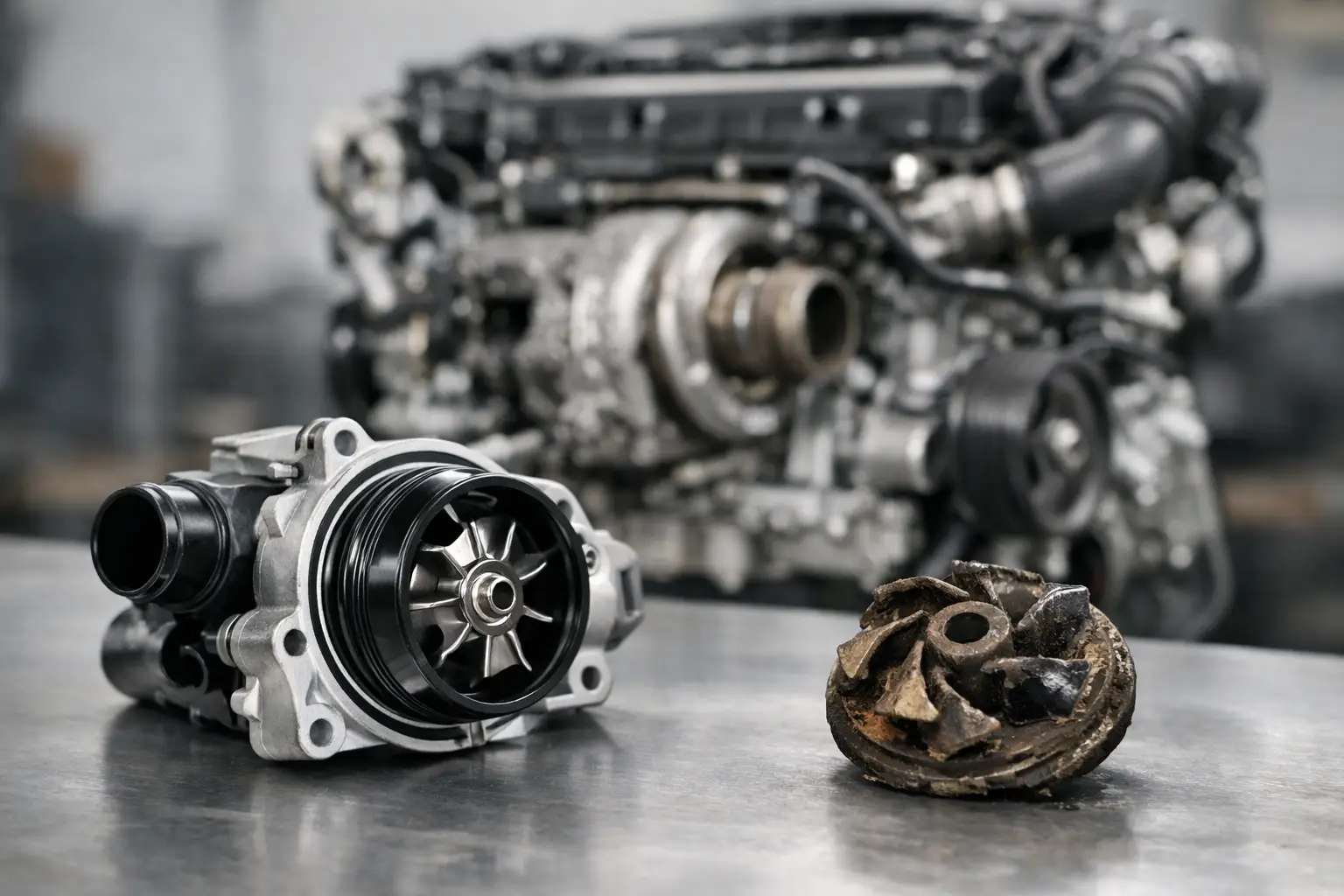
A faint coolant smell after parking, a low coolant warning that seems to come and go, or pink residue around the front of the engine – these are often the first clues of VW EA888 water pump failure. On VAG cars, this is one of those faults that can start small and become expensive if it is ignored for too long.
The EA888 engine is fitted across a wide range of Volkswagen Audi Group models, including many Audi, Volkswagen, Škoda and SEAT cars. It is a strong and capable engine when maintained properly, but water pump and thermostat housing issues are common enough that owners should know what to look for. If you drive one of these cars daily, spotting the problem early can save you from overheating, breakdowns and repeat visits to the garage.
Why VW EA888 water pump failure is so common
The main issue is not always the pump itself in the old-fashioned sense of a simple leaking seal or worn bearing. On many EA888 engines, the water pump is part of a larger plastic thermostat housing assembly. That means several possible failure points are built into one unit.
Over time, the plastic can warp or crack with repeated heat cycles. Seals can harden, joints can start to seep, and the thermostat section can also fail. In practice, what many owners call a water pump failure is often a leak or fault within the wider pump and housing assembly.
That matters because the fix is rarely a quick top-up and carry on. If the unit is leaking, it generally needs proper diagnosis and replacement rather than a temporary patch. Cheap repairs or partial fixes often do not last.
Which cars are affected?
The EA888 family covers a lot of ground, so there is no single model list that suits every reader. Broadly, if you have a 1.8 TSI or 2.0 TSI petrol VAG model from the last decade or so, there is a fair chance it uses some version of the EA888 engine.
That includes cars such as the VW Golf GTI, Golf R, Passat, Tiguan, Audi A3, A4, A5, TT, S3, Škoda Octavia vRS, Superb and various SEAT Leon models. Engine generation, year and exact specification matter, so it is always worth checking by registration or engine code rather than assuming.
Common symptoms of EA888 water pump problems
The most obvious sign is coolant loss. You may find yourself topping up the expansion tank every few weeks even though there is no dramatic puddle under the car. These leaks are often slow at first, and because coolant can evaporate on hot engine components, the evidence is not always clear.
Another common symptom is a sweet coolant smell after a journey. Owners sometimes notice it most when getting out of the car or opening the bonnet after the engine has warmed through. Pink or white crusty residue around the pump housing area can also point to a coolant leak.
In more advanced cases, you may see a low coolant warning on the dash, fluctuating temperature behaviour, or poor heater performance. If the cooling system cannot maintain the right flow and pressure, the cabin heater may blow cooler than expected, especially at idle.
Overheating is the symptom nobody wants to see, but it can happen if the leak worsens or the thermostat function is affected. Once temperature control starts to go off course, the risk to the engine increases quickly.
What causes the failure?
Heat is the main long-term enemy. These engines run hot, and modern cooling systems are more integrated and more compact than older designs. The plastic housing assembly expands and contracts constantly, and eventually the material can weaken.
Age and mileage both play a part, but there is no perfect timetable. Some cars develop leaks earlier than expected, while others go much longer without issue. Driving style, engine bay temperatures, service history and the quality of previous repairs can all influence when the problem appears.
It is also worth saying that not every coolant loss issue on an EA888 is automatically the water pump. There can be leaks from pipework, radiators, expansion tanks or other cooling system components. That is why a proper inspection matters before any parts are ordered.
Why early diagnosis matters
A minor leak is still a leak. If coolant level drops too far, the engine can overheat, and that is when a manageable repair can turn into something far more serious.
Modern VAG engines do not respond well to being run low on coolant. Persistent overheating can lead to head gasket trouble, warped components and expensive engine work. Even if you avoid major damage, repeated topping up without solving the root cause usually means more inconvenience and more risk of getting stranded.
For owners using their car for commuting, school runs or regular motorway mileage, reliability matters as much as repair cost. Catching the fault while it is still a straightforward pump and housing replacement is usually the best outcome.
Diagnosing VW EA888 water pump failure properly
This is one of those jobs where experience with VAG vehicles makes a difference. Coolant leaks can track across the engine and make the source look less obvious than it really is. A technician familiar with the EA888 layout will know the common leak points, how to pressure test the system properly and what else to check while access is available.
A good diagnosis should confirm whether the issue is the water pump assembly, thermostat housing, associated seals or another part of the cooling system. It should also check for any signs that the engine has already been running too hot.
That matters for two reasons. First, you want the actual cause fixed the first time. Second, you do not want to replace a pump only to find another weak cooling system component fails shortly afterwards.
What is involved in the repair?
In most cases, the repair means replacing the water pump and thermostat housing assembly rather than attempting to repair individual parts of it. Depending on the engine variant and surrounding components, access can be awkward, so this is not just a five-minute bolt-off, bolt-on job.
Coolant will need to be drained and refilled correctly, the system bled properly, and the repair checked for leaks once back at temperature. On some cars, it also makes sense to inspect nearby components at the same time, especially if there are any signs of ageing hoses or previous coolant contamination.
Parts quality matters here. Inferior components can lead to repeat failures, which is why using OEM or equivalent quality parts is the sensible route. A cheaper part is not much of a saving if the same job has to be done again.
Can you keep driving with a leaking water pump?
Sometimes, briefly, yes. Sensibly, not for long.
If the leak is very minor and the coolant level is stable enough to get the car to a booked inspection, that is one thing. But continuing to use the car normally while topping up every few days is a gamble. A small seep can become a bigger leak without much warning, especially once the engine is fully hot.
If you have a coolant warning, visible dripping, rising temperature or poor heater performance, it is best not to push your luck. The cost of recovery is usually far lower than the cost of engine damage.
Is this a known weak point or just bad luck?
For EA888-powered VAG cars, it is fair to call it a known weak point. That does not mean every car will suffer from it on the same timetable, and it does not mean the engine is fundamentally bad. It means this is one of the more familiar failures specialists see and deal with regularly.
That is often frustrating for owners, especially if the car feels otherwise healthy. The upside is that because the issue is well known, it can usually be identified and repaired efficiently by a workshop that knows these engines inside out.
At Mechalex, this is exactly the sort of VAG-specific fault that benefits from the right experience, the right diagnostic equipment and a repair approach based on doing the job properly rather than guessing.
How to reduce the risk of future problems
You cannot completely prevent age-related cooling system failures, but you can improve your odds. Paying attention to coolant warnings, checking the level occasionally when the engine is cold, and getting small leaks investigated early all help.
It also pays to avoid the bargain-basement repair route. Proper diagnosis, correct coolant, and quality replacement parts matter more than shaving the bill down at the expense of reliability. With cooling system work, the cheapest option often becomes the expensive one later.
If your EA888 engine smells of coolant, keeps asking for top-ups or shows any sign of temperature instability, do not wait for a breakdown to confirm what is already starting to happen. A cooling system fault rarely improves on its own, and an early repair is usually the simplest way to keep the car dependable.