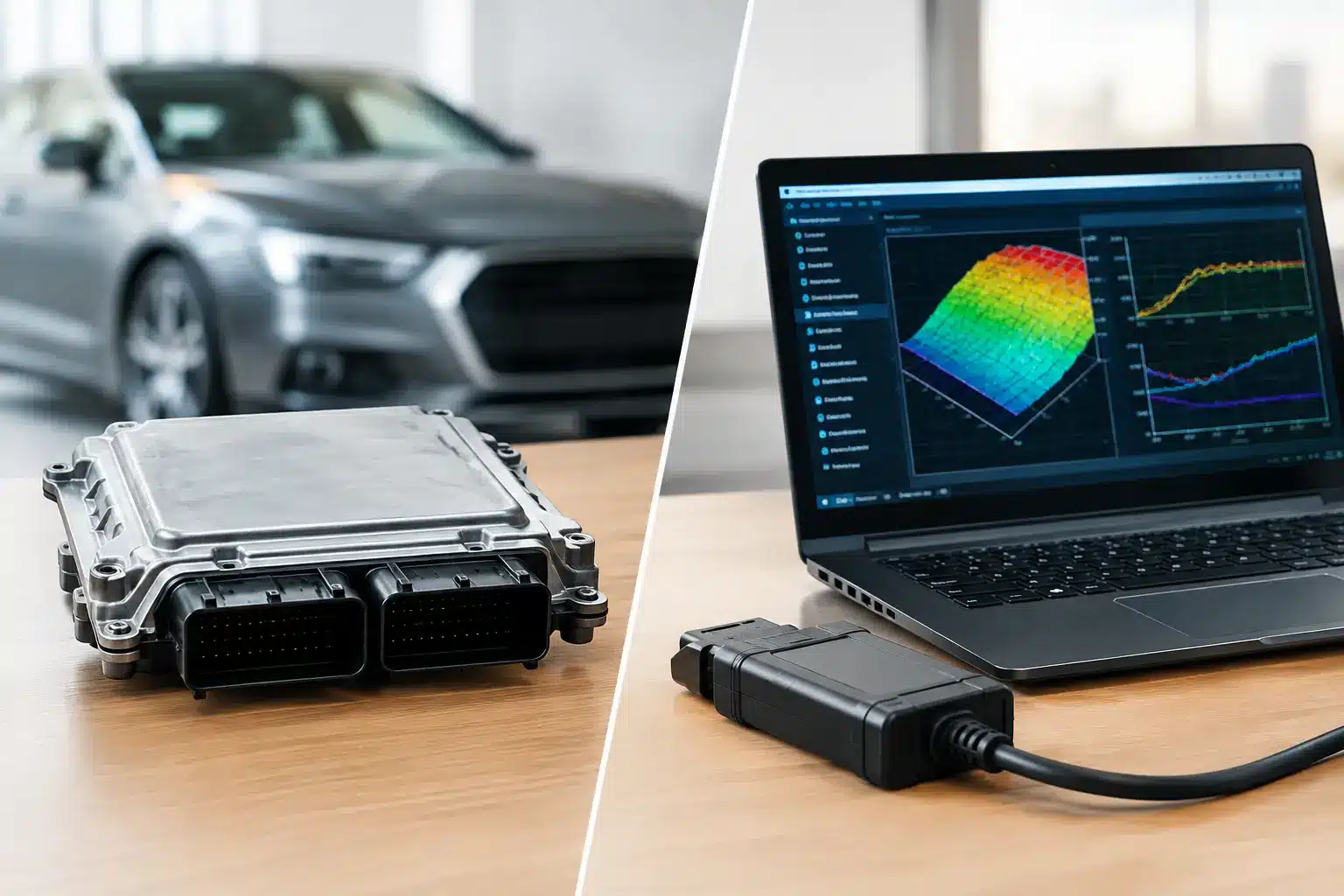

A warning light is only the start of the conversation. On an Audi, Volkswagen, Škoda or SEAT, VAG diagnostics should identify why a fault has appeared, not simply report a code and replace the first part named on a screen. That distinction can save considerable time, cost and repeat visits.
Modern VAG cars share sophisticated electronic systems across their engines, gearboxes, brakes, four-wheel-drive systems and comfort features. They are dependable when maintained properly, but faults can have several possible causes. A good diagnostic process combines the correct equipment with VAG knowledge, test results and careful inspection.
What proper VAG diagnostics involves
A fault code is useful evidence, but it is not a diagnosis. For example, an engine management fault may point to an air-flow, fuel-pressure or boost-control issue. The component named in the code may be the source of the problem, but it may also be responding to a wiring fault, vacuum leak, worn mechanical part or an issue elsewhere in the system.
Proper VAG diagnostics starts by discussing what the vehicle is doing. Is the problem intermittent? Does it occur from cold, under acceleration, after a longer motorway journey or only when the car is parked overnight? Those details help narrow the investigation before any parts are considered.
The technician can then carry out a full vehicle scan, review live data, check stored and pending faults, and compare readings against what the system should be seeing. Depending on the symptom, this may be followed by electrical testing, pressure checks, smoke testing for intake leaks, road testing or mechanical inspection.
This approach matters because clearing a warning light is not the same as fixing its cause. If the fault returns, the car has not been repaired.
Common problems VAG diagnostic testing can uncover
Audi, VW, Škoda and SEAT vehicles often use similar engines, transmissions and control systems, but the same dashboard message can mean different things depending on the model, age and specification. A thorough assessment is especially valuable when the car drives normally most of the time, as intermittent faults are usually the easiest to misdiagnose.
Common reasons owners arrange diagnostic work include engine management lights, loss of power, poor fuel economy, rough running, starting problems and cooling-system warnings. Electronic parking brake, ABS, airbag and tyre-pressure warnings also require the correct equipment to read the relevant control module properly.
Transmission concerns need equally careful attention. A DSG that hesitates, jolts when pulling away, selects gears harshly or displays a gearbox warning may need more than a basic scan. Fluid condition and service history, adaptation values, wiring, sensor readings and mechatronic operation all need consideration before deciding on the right repair.
For four-wheel-drive models, Haldex-related faults can lead to warning lights, reduced traction or a vehicle that no longer drives as expected in poor conditions. A service issue, contaminated oil, a pump concern or a stored electrical fault may be involved. Replacing parts without proving the cause can become expensive quickly.
Warning lights should not be ignored
A steady amber light does not always mean the car must stop immediately, but it does mean the system has detected a fault that deserves investigation. A flashing engine management light, red warning light, severe loss of power, overheating message or gearbox fault that prevents normal driving should be treated more urgently.
If you are unsure whether it is safe to continue, avoid hard acceleration and arrange advice before a short issue becomes a larger repair. Continuing to drive with an active misfire, for instance, can damage the catalytic converter.
Why generic code reading is not enough
Many drivers have access to a handheld reader, and it can be helpful for identifying that a fault exists. The limitation is that it rarely explains the full picture. Generic readers may show only basic powertrain codes and cannot always access the VAG-specific data needed to investigate modules such as DSG, Haldex, steering, climate control or body electronics.
Even with professional scan equipment, expertise still matters. Live readings must be interpreted in context. A low boost reading, for example, could be caused by a control issue, leak, sensor fault, actuator problem or mechanical wear. The right answer comes from testing, not guesswork.
That is why the cheapest initial code read is not always the best value. It may confirm the warning light, but it can leave the underlying problem unresolved. Targeted investigation costs more time at the outset, yet often avoids unnecessary replacement sensors, coils, valves or control units.
When to book VAG diagnostics
Book an inspection when a warning light appears, but do not wait for a dashboard message if the vehicle feels different. A change in performance, fuel use, starting behaviour, idle quality, gear changes or braking feel is worth checking while the symptoms are still clear.
It is also sensible to arrange diagnostics before authorising a major repair suggested elsewhere, particularly where the recommendation is based solely on a stored code. Some faults are straightforward and the proposed repair may be correct. Others need confirmation before committing to costly components.
Diagnostics can also be useful after repairs have been carried out. If a warning returns, or the vehicle still does not drive correctly, the original fault may not have been fully resolved. This is particularly relevant on cars with multiple related systems, where one problem can trigger several codes.
Where to get an Audi DSG service and fault diagnosis
An Audi DSG service should be carried out by a workshop that understands the gearbox fitted to your exact vehicle, follows the appropriate service procedure and uses suitable oil and parts. Not every DSG unit has the same fluid specification, interval or servicing method, so a one-size-fits-all approach is not appropriate.
If your Audi is also displaying a gearbox warning or shifting poorly, it needs diagnosis as well as routine servicing. A service can address maintenance requirements, but it will not automatically cure a mechatronic, sensor, adaptation or mechanical fault. Combining the two without first identifying the issue can lead to false expectations.
The same principle applies to Volkswagen, Škoda and SEAT DSG models. A specialist workshop can establish whether the concern is due to overdue maintenance, a software or adaptation issue, an electrical fault or wear within the transmission. The repair plan should follow the evidence, with a clear explanation before work begins.
A practical local alternative to the main dealer
For drivers in Aldermaston, Tadley, Basingstoke, Reading and Newbury, a VAG-focused independent workshop provides a practical route to dealer-level diagnostic capability without automatically paying main-dealer prices. It is particularly helpful when a daily commuter car, family SUV or performance model needs skilled fault-finding but cannot be off the road for long.
Mechalex uses modern diagnostic equipment alongside more than 30 years of VAG experience. That combination is useful because technology identifies information quickly, while experience helps distinguish a meaningful fault from a misleading symptom. OEM or equivalent-quality parts are used where repairs are required, with the aim of fixing the vehicle properly rather than applying a temporary workaround.
Courtesy-car availability can also make a real difference for customers travelling from the surrounding area, especially where further testing or parts ordering is needed. It is worth asking about this when booking, as diagnostic work can vary from a straightforward same-day investigation to a more involved process for an intermittent issue.
What to bring to a diagnostic appointment
The best diagnostic appointment begins with good information. If possible, note when the warning first appeared, how often it happens, what conditions trigger it and any recent work completed on the car. A photograph of the dashboard warning can be useful if the message disappears before the booking.
Be clear about changes in the way the vehicle feels, even if they seem unrelated. A brief hesitation, a click on starting, a smell after a journey or a change in gearbox behaviour can all be relevant. Service records are helpful too, especially for DSG, Haldex, cambelt and water-pump work.
Accurate VAG diagnostics is ultimately about reducing uncertainty. Rather than paying to replace possibilities, you should have a reasoned diagnosis, a sensible repair recommendation and the confidence to make the right decision for your car. If your Audi, Volkswagen, Škoda or SEAT is warning you that something is wrong, arranging a proper assessment early is usually the most cost-effective next step.