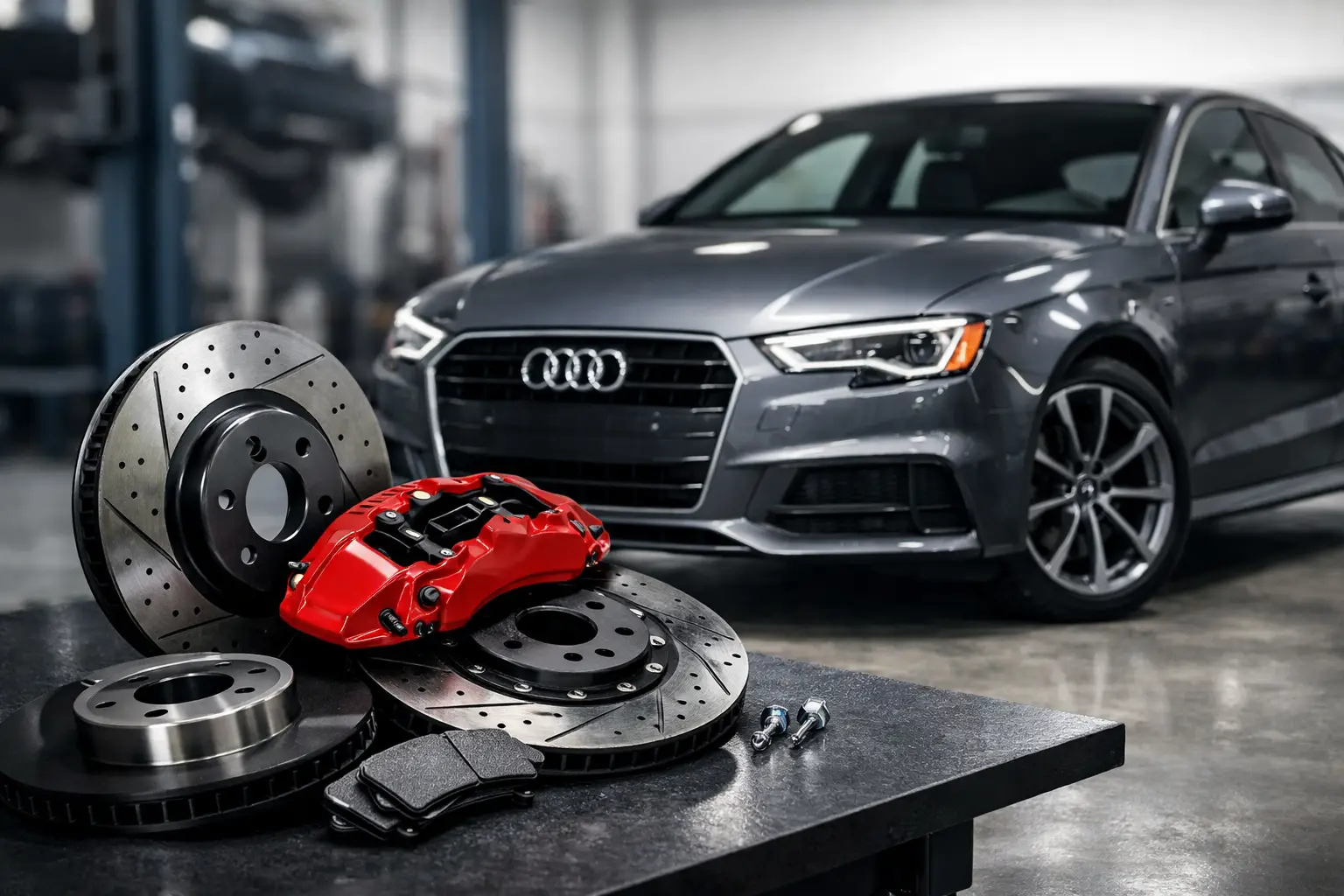
If your Audi A3 has started to feel less sharp under braking, the answer is not always to buy the most expensive pads and discs you can find. On these cars, the best result usually comes from matching the brake setup to how the car is actually used. A school-run 1.6 TDI, a motorway-driven 2.0 TFSI and a tuned S3 all want different things from their brakes.
That is why there is no single answer to the best brakes for Audi A3. There is, however, a right answer for your A3, your driving and your budget.
What makes the best brakes for Audi A3 owners?
For most owners, the right brake setup is one that stops confidently from cold, stays consistent in wet weather, does not squeal every time you reverse off the drive, and lasts well without covering the wheels in dust. That sounds obvious, but it rules out a lot of parts that look impressive on paper.
Audi A3 models span a wide range. A standard 8P or 8V used for commuting does not need an aggressive fast-road pad compound. Equally, if you have an S line, Black Edition, quattro model or an S3 that is driven hard, a very basic aftermarket pad can leave the pedal feeling weak when the brakes get hot.
The best brakes for Audi A3 drivers are usually those that balance four things properly – braking performance, noise, dust and service life. If one of those matters more to you than the others, your ideal setup changes.
Start with how the car is used
Before choosing brands, it helps to be honest about the job the brakes need to do.
If your A3 spends most of its life on local roads, carrying family, shopping and the usual daily mileage, OEM or OEM-equivalent discs and pads are normally the best choice. They give predictable bite from cold, good wear rates and the least hassle.
If the car does regular motorway work, quality still matters, but fade resistance becomes a little more relevant. Long high-speed braking loads the system more than stop-start town use, so cheaper pads can begin to feel inconsistent.
If your Audi A3 is mapped, driven briskly on B-roads or used as an enthusiast car, that is where a mild performance pad and a high-quality disc can make sense. Not a track-only setup – just something with better temperature tolerance and pedal consistency.
Track use is a different conversation entirely. A brake package that works brilliantly on circuit can be noisy, dusty and unpleasant on the road. For most A3 owners, that is a compromise too far.
Best brake types for an Audi A3
OEM and OEM-equivalent brakes
For the majority of cars, this is the sweet spot. ATE, TRW, Pagid, Brembo OE lines and other recognised OEM-equivalent brands are usually the sensible answer. They are designed to behave properly in normal road conditions, and on VAG cars that matters.
A good OEM-style setup tends to offer the best all-round experience. You get solid initial bite, stable pedal feel and fewer complaints about squeal or roughness. If you want your car to feel as Audi intended, this is normally where to look first.
This route is also often the best value in the long run. Cheap brakes can look attractive at purchase, but poor friction material, inconsistent machining or weak anti-noise shims often mean earlier replacement or a return visit to sort vibration and noise.
Fast-road brake setups
If you want more confidence without turning the car into a track project, a fast-road setup can work well. Typically that means a quality plain or lightly grooved disc paired with a performance-focused road pad from a recognised manufacturer.
The gain here is not always a dramatic reduction in stopping distance. It is usually better consistency, stronger bite once warm and more resistance to fade when the car is driven hard.
The trade-off is that some performance pads can be noisier and dustier, and a few feel underwhelming when stone cold on winter mornings. That is why the best brakes for Audi A3 enthusiasts are not automatically the best brakes for every Audi A3 owner.
Budget aftermarket brakes
These are tempting, especially when a car needs discs and pads all round. Sometimes they are acceptable for a lightly used car, but quality varies a lot. With lower-end parts, the common issues are poor pedal feel, vibration, corrosion on the discs and excessive noise.
On an Audi A3, where owners usually expect the car to feel refined and confidence-inspiring, cutting too many corners on brakes rarely pays off. Brakes are not the place to gamble on unknown brands.
Should you choose drilled, grooved or plain discs?
For most road cars, plain discs are still the best option. They offer reliable surface contact, good heat management for normal use and tend to be quieter. They also avoid some of the cracking risks associated with poor-quality drilled discs.
Grooved discs can be useful on harder-driven cars because they help clear petrol and debris from the pad surface, and they can improve pedal consistency. The downside is extra noise and potentially faster pad wear.
Drilled discs are often chosen for appearance first. On a road-driven A3, they are rarely necessary unless they are part of a high-quality engineered setup. A lot of aftermarket drilled options look sporty but add little for real-world driving.
If your priority is dependable braking on the road, plain high-quality discs are usually the right call.
Pads matter as much as discs
Owners often focus on discs because they are visible through the wheel, but the pad compound has a huge effect on how the car feels. Two A3s with the same discs can brake very differently depending on pad choice.
A softer road pad may feel progressive and refined, with good cold bite and lower noise. A more aggressive pad may offer stronger friction at higher temperatures but create more dust and squeal. Neither is automatically better.
This is where fitting the right parts as a package matters. A decent disc paired with the wrong pad can feel disappointing. So can a high-performance pad on tired or poor-quality discs.
When bigger is not always better
Some owners consider upgrading to larger brakes from another VAG model, especially on 8P and 8V platforms where parts sharing is common. In some cases, that can be a worthwhile upgrade, especially for higher-powered cars. But bigger brakes are not a magic fix.
Brake performance depends on the whole system – pad compound, tyre grip, fluid condition, caliper health and how the ABS is managing the stop. If your current setup is underperforming, the cause may simply be worn parts, glazed pads, sticking sliders or old brake fluid.
A standard A3 with fresh, correctly specified quality brakes often feels far better than a poorly planned oversized conversion. It is usually better to restore the system properly before chasing upgrades.
Don’t ignore the rest of the braking system
If you are choosing the best brakes for Audi A3 ownership, the parts themselves are only half the story. Fitting quality discs and pads onto a car with corroded carriers, seized guide pins or contaminated fluid will not give the result you expect.
We see this regularly with VAG cars. Owners fit new parts but still complain of poor feel or uneven braking. The issue turns out to be sticking hardware, worn hoses, an electronic handbrake concern on later models, or simply brake fluid that should have been changed long ago.
This is why proper inspection matters. A brake job done correctly should include checking caliper movement, pad wear pattern, disc condition, brake hoses and fluid quality, not just bolting on new components.
So what should most Audi A3 owners buy?
For the average road-driven Audi A3, the best setup is usually quality OEM or OEM-equivalent plain discs with matching pads from a trusted manufacturer. It delivers the strongest balance of stopping power, refinement and value.
If you drive harder than average, have a more powerful model or want a little more confidence under repeated heavy braking, stepping up to a mild fast-road pad with a premium disc can be worthwhile. Just go in expecting a few compromises in dust or noise.
What we would not normally recommend is choosing the cheapest brakes available or buying heavily marketed performance parts without thinking about how the car is used. The best part on the shelf is not always the best part for your Audi.
If you are unsure, getting the car assessed by a VAG specialist is the safest route. On cars like the A3, correct specification matters, and so does proper fitting. At Mechalex, that usually means recommending OEM or equivalent parts unless the car and the driver genuinely justify something more focused.
A good brake setup should make your Audi A3 feel calm, predictable and confidence-inspiring every time you press the pedal – not just look good through the alloys.