
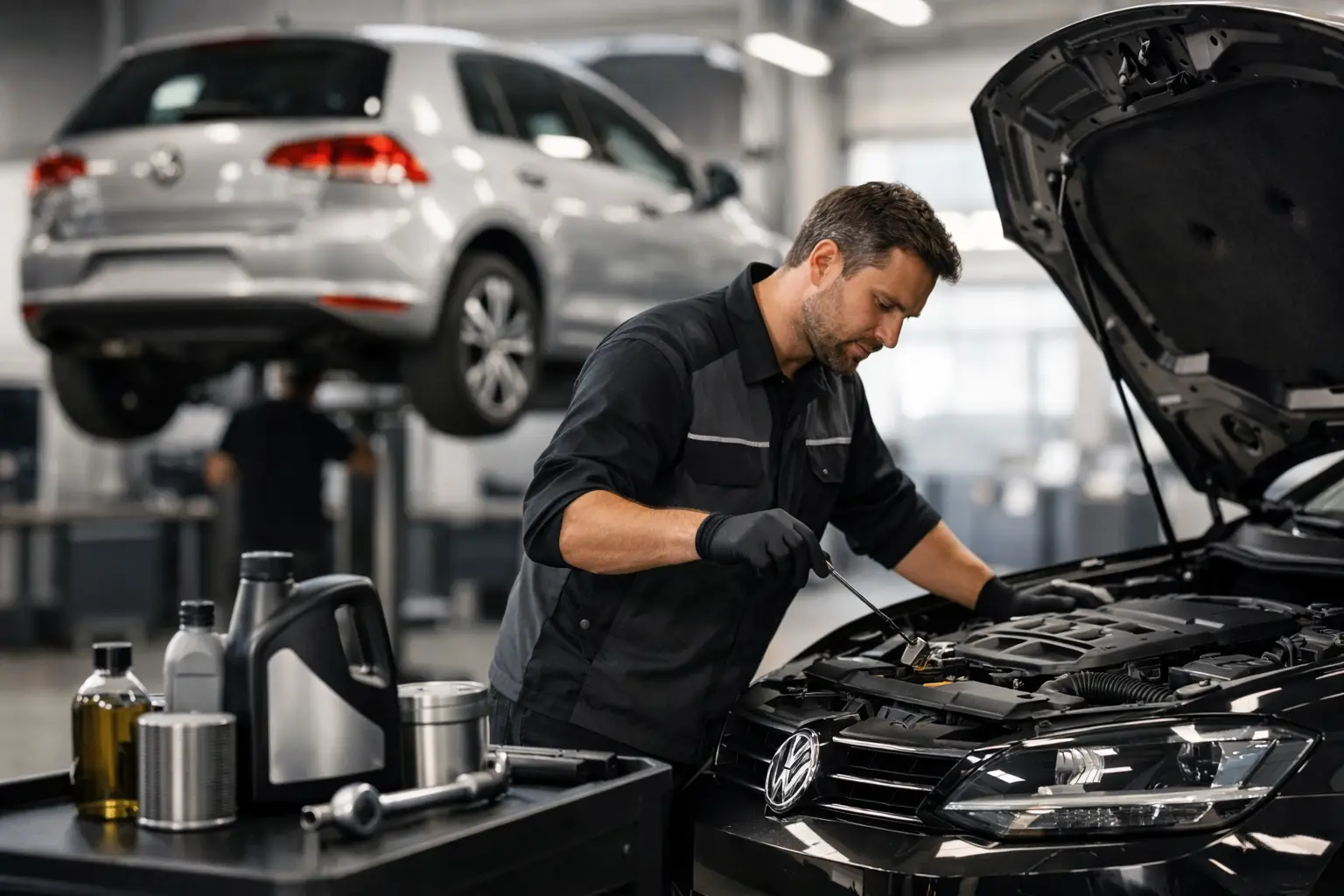
If your dashboard says the next service is due in 18,000 miles, but a friend insists you should be changing the oil every year, it is no surprise VAG longlife servicing causes confusion. This guide to VAG longlife servicing explains how the system works on Audi, Volkswagen, Škoda and SEAT models, when it makes sense, and when a fixed interval is the better choice.
What VAG longlife servicing actually means
Longlife servicing is a variable service regime used across many Volkswagen Audi Group vehicles. Instead of booking servicing at one fixed mileage point every year, the car monitors driving conditions and calculates when an oil service is due.
In simple terms, the interval changes depending on how the car is used. A car doing regular motorway miles at stable temperatures will often go longer between services than one doing short school runs, stop-start commuting or repeated cold starts.
That sounds sensible because, in principle, it is. The car is not guessing. It uses inputs such as engine temperature, load, running time and driving style to estimate oil condition and service need.
For many owners, though, the phrase longlife can be misleading. It does not mean maintenance-free, and it certainly does not mean every component on the car is happy being left for two years.
How the longlife schedule works
Most VAG longlife schedules allow up to around 18,000 to 20,000 miles or up to 24 months between oil services, depending on model and engine. Inspection items still sit alongside that, so servicing is not just a case of waiting until the oil warning appears and ignoring everything else.
The system also depends on the correct specification oil being used. That is a non-negotiable part of the schedule. If the wrong oil goes in, the whole basis of the longlife interval falls apart because the oil may not cope with the extended service period.
This is one reason specialist servicing matters on VAG vehicles. These cars often have very specific oil standards, and the detail varies by engine type, age and emissions system. Getting that wrong can affect engine wear, oil consumption and, on some models, emissions-related components.
A guide to VAG longlife servicing for real-world driving
On paper, longlife servicing suits drivers who cover decent mileage in consistent conditions. Think of someone travelling regularly between Basingstoke and Reading, or doing longer A-road and motorway runs from Newbury or Tadley. In that kind of use, the engine gets fully warm, moisture burns off properly, and the oil tends to age more slowly.
Where longlife servicing becomes less convincing is in harsher real-world use. Lots of short local trips around Aldermaston, repeated cold starts, long periods of idling, towing, or enthusiastic driving all put more stress on the oil and engine systems. Even if the service indicator has not triggered early, those conditions can make a fixed annual oil service the safer option.
Diesel engines deserve a closer look here. If the car is used mainly for short journeys, issues around soot loading and DPF regeneration can make a long interval less attractive. Petrol turbo engines can also benefit from more frequent oil changes, especially where owners want to protect the turbocharger and keep internal deposits under control.
When longlife servicing makes sense
Longlife servicing can work well if your car is used regularly for longer runs, is maintained properly, and the correct oil and parts are always used. For some owners, it offers convenience without compromising reliability.
It can also suit leased or newer vehicles where the car is driven as intended, serviced on time, and not kept long enough for owners to worry about wear over very high mileages. If your driving pattern is steady and your vehicle has a clean service history, remaining on longlife may be perfectly reasonable.
There is also a cost and downtime benefit. Fewer workshop visits can be useful if the car is mostly doing straightforward miles and your schedule is busy.
When fixed servicing is often better
For many VAG owners, a fixed servicing schedule of roughly 10,000 miles or 12 months is the better long-term decision. That is particularly true if you plan to keep the vehicle for years rather than hand it back at the end of a finance agreement.
More frequent oil changes are a relatively modest spend compared with the cost of engine repairs, turbo issues or excessive internal build-up. This is especially relevant on direct-injection petrol engines, older diesels, or any car with a hard-working turbocharged setup.
Enthusiast-owned cars often fall into this category too. If the car is driven briskly, tuned, or expected to deliver reliable performance, fixed interval servicing gives you a better safety margin. The same goes for cars covering mixed local mileage rather than clean motorway use.
What longlife servicing should include
A proper service is not just oil and a stamp. On VAG vehicles, it should involve the correct grade and specification oil, a quality oil filter, and a structured inspection of key safety and wear items.
That includes brakes, tyres, suspension components, steering, battery condition, fluid levels, filters and service indicator reset procedures done correctly. Depending on the model, mileage and age, there may also be separate requirements for brake fluid, spark plugs, fuel filters, DSG servicing, Haldex servicing and cambelt replacement.
This is where owners sometimes get caught out. Longlife oil servicing does not replace those separate maintenance items. A car can be within its oil service interval but overdue for DSG oil, brake fluid or a timing belt. Treating longlife as a blanket rule for the whole car is a mistake.
Common misunderstandings about VAG longlife servicing
One of the biggest misunderstandings is that longlife is always the premium option. It is not necessarily better. It is simply a different servicing regime designed around certain use patterns.
Another is that the dashboard countdown tells the whole story. It tells you when the car estimates an oil service is due, but it does not replace experienced eyes on the vehicle. A technician familiar with VAG models will often spot developing issues well before they become expensive faults.
The third is that any garage can service a VAG car in the same way. Basic servicing is basic servicing to a point, but these vehicles often have platform-specific requirements, known weak spots and software or diagnostic considerations that generalists may miss.
Why specialist knowledge matters on VAG vehicles
Audi, VW, Škoda and SEAT models share a lot of engineering, but that does not make them simple. Different engines, gearbox types and four-wheel-drive systems all have their own service needs, and the right recommendation often depends on how the car is used rather than what the handbook says in isolation.
A specialist workshop can help you decide whether to stay on longlife or switch to fixed servicing based on your actual driving pattern. That is more useful than a one-size-fits-all answer.
For drivers around Aldermaston, Tadley, Basingstoke, Reading and Newbury, using a local VAG specialist also means you do not have to choose between convenience and technical capability. You can get dealer-level diagnostic equipment, experienced technicians and OEM or equivalent parts standards without the main dealer pricing or the less personal approach many owners are trying to avoid.
So, should you choose longlife or fixed?
It depends on the car, the engine and your usage. If you cover high motorway mileage and maintain the vehicle properly, longlife servicing can be a sensible fit. If the car does short trips, mixed local driving, harder use, or you want to keep it in the best possible mechanical condition over the long term, fixed interval servicing is often the smarter option.
The best choice is the one that matches reality, not just the longest number on paper. A good workshop will tell you that honestly, even if it means recommending more frequent servicing.
At Mechalex, that conversation is based on how you actually use your Audi, Volkswagen, Škoda or SEAT, not on pushing a generic schedule. If you are not sure which regime your car is on, or whether it still suits your driving, it is worth getting it checked before the next service light becomes the only thing making the decision for you.
A well-serviced VAG car usually tells its story in the miles you do not lose to avoidable faults, and that is what really matters.