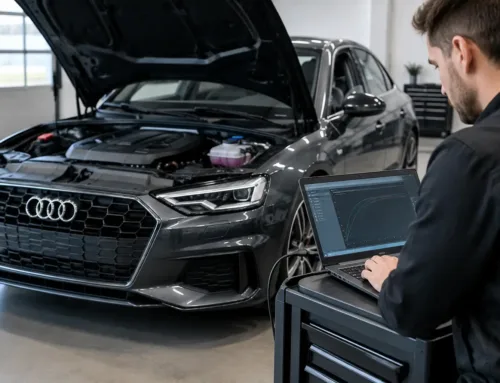
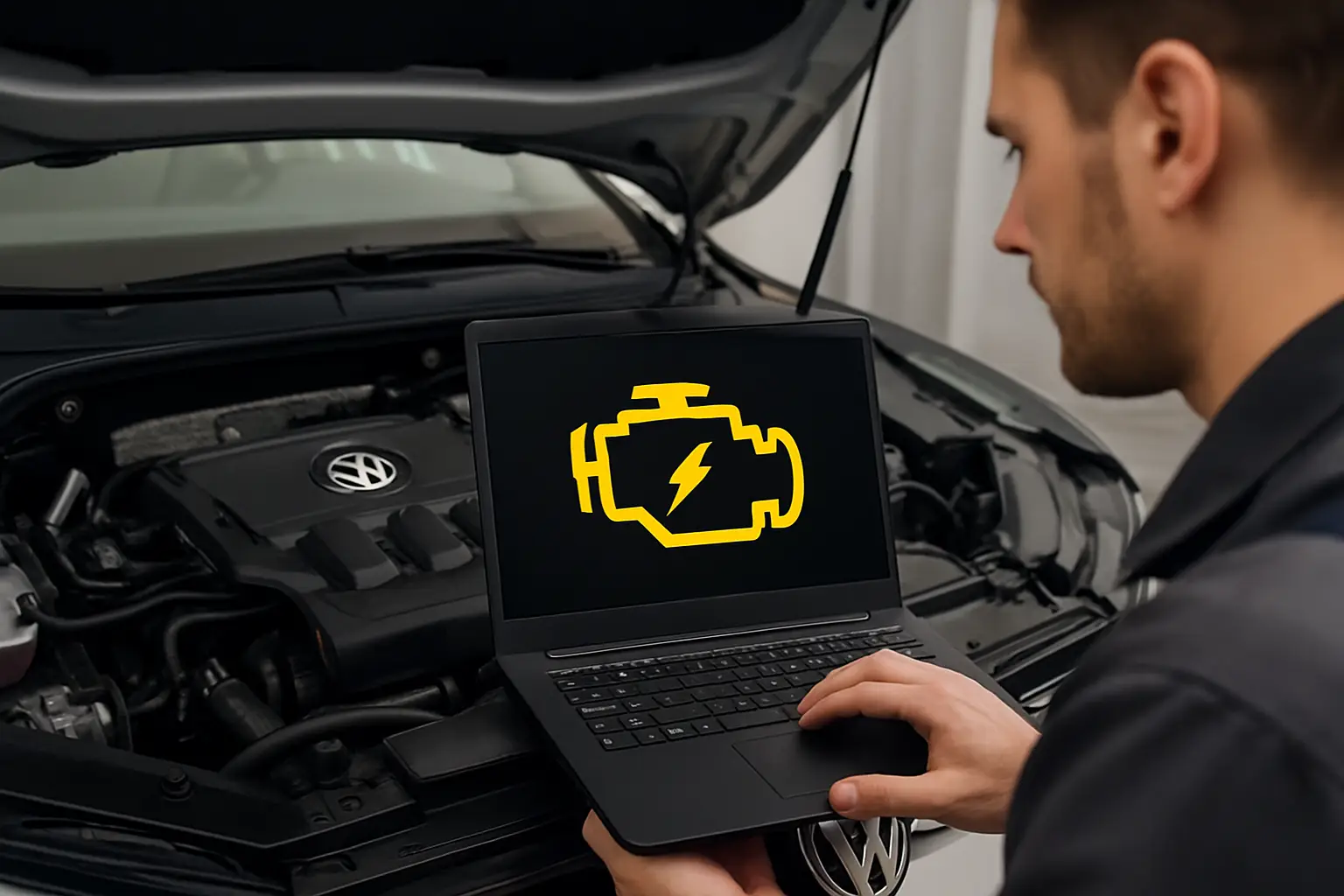
The engine management light always seems to choose the worst possible moment – the school run, the M4, or five minutes before an MOT. On VW models it can be as minor as a loose fuel cap or as involved as a misfire that risks damaging the catalytic converter. The trick is not guessing. Good diagnostics are about narrowing the fault down quickly, safely, and without replacing parts on a hunch.
What the VW engine management light is actually telling you
On most Volkswagens the engine management light (EML) is the car’s way of saying the ECU has detected something outside its expected range. That might be emissions-related, a sensor signal that does not make sense, or a mechanical issue that shows up in the data as “implausible”.
How it behaves matters. A steady light usually means the car thinks it can protect itself and continue running, even if performance or economy is affected. A flashing light is different – it often indicates an active misfire, and continued driving can overheat and damage the catalytic converter. If it is flashing, ease off, avoid hard acceleration, and get it checked as soon as practical.
It is also worth noting that some VWs will store faults without showing a warning straight away. Others will light the EML and then switch it off again once the issue stops occurring, even though the fault code remains stored. That is why “the light went off” is not the same as “the problem has gone”.
VW engine management light diagnostics: the right mindset
Proper VW engine management light diagnostics are less about reading a code and more about proving the cause. A fault code is a signpost, not a verdict. For example, a code that mentions an oxygen sensor can be caused by a genuine sensor failure, but it can also be triggered by an exhaust leak, a misfire, a vacuum leak, fuel trim issues, or wiring problems.
The best approach is staged:
First, confirm the symptom and the conditions it appears under. Cold start only? Only on a long motorway run? Only when the tank is low? Those details affect the test plan.
Then, read fault codes and freeze frame data. Freeze frame tells you what the ECU saw at the moment it decided to log the fault – engine load, RPM, coolant temperature, fuel trims and more.
Finally, test the system that relates to the code. That might mean smoke-testing for air leaks, checking live data for sensor plausibility, doing an injector balance check, or inspecting the ignition system under load.
Quick checks you can do without tools
There are a few simple checks that can save you time, especially if the car is otherwise running normally.
Start with the fuel filler cap on petrol models. If it is not fully seated, EVAP system checks can fail and trigger a warning. Tighten it until it clicks and monitor over the next few drive cycles.
Next, look and listen. Rough idle, a strong fuel smell, hissing from the intake area, or a ticking exhaust leak can all be clues. Check for obvious loose hoses around the intake and breather system if you can see them easily. Do not start pulling covers and pipes off if you are not confident – turning a small issue into an air leak will only muddy the waters.
If the car has gone into reduced power (limp mode), take note of when it happens. Some faults are load-related and only show when the turbo is commanded to make boost or when the DSG changes up under heavier throttle.
Common VW causes behind the EML (and why it depends)
Volkswagen engines span a lot of technology – naturally aspirated petrol, turbocharged TSI/TFSI, TDI diesels, hybrids on newer platforms. The EML can mean very different things depending on the engine and mileage.
Misfires are a frequent culprit on petrol engines. They can come from coils, spark plugs, injector issues, carbon build-up on intake valves (common on direct-injection engines), or even a small air leak that leans the mixture. The trade-off here is that the car may feel only slightly rough, but the risk to the catalytic converter increases if you continue driving with an active misfire.
Air and vacuum leaks can trigger fuel trim codes and drivability issues. Split breather hoses, PCV valve problems, or intake pipe leaks can all cause the ECU to add or subtract fuel to compensate. The symptom may be subtle: slightly hesitant acceleration or poor economy rather than a dramatic breakdown.
Turbo control issues can show up as underboost or overboost faults. On some engines this can relate to diverter valves, boost leaks, wastegate control, or sensor plausibility problems. With turbos, guessing gets expensive quickly. A pressure test and live data comparison is the sensible route.
EGR and intake soot problems are common on many diesels. An EGR valve sticking, a cooler issue, or a differential pressure sensor reading that does not add up can trigger warnings and limp mode. Some cars will cope for weeks, others will drop power without much warning – it depends how far out of range the system is and how the ECU chooses to protect the engine.
DPF-related faults can also illuminate the EML, sometimes alongside a glow plug light. Short journeys, repeated interrupted regenerations, or an underlying fault (like a temperature sensor giving incorrect readings) can all lead to the ECU deciding regeneration is not completing properly.
Sensor and wiring faults are the wildcards. A perfectly healthy engine can still log faults if a connector is corroded, a wire is chafed, or a sensor signal intermittently drops out. That is why a good inspection and proper testing matter just as much as the scan.
What a code reader can and cannot do
A basic OBD code reader can be useful for peace of mind, but it has limits. It will often give generic P-codes and a short description. That may point you in the right direction, but it does not always show manufacturer-specific detail, measured values, or guided test plans.
On VAG cars, deeper diagnostics benefits from VAG-capable equipment that can access more control modules, show measuring blocks and live data in greater detail, and help with adaptations and basic settings where appropriate.
If you do use a code reader, avoid clearing the codes straight away. Clearing wipes the evidence. It also resets readiness monitors, which can be relevant for MOT emissions checks. Better to note the codes, the circumstances, and whether the light is steady or flashing.
What professional diagnostics looks like on a VW
When we carry out VW engine management light diagnostics properly, we are trying to answer two questions: what failed, and why.
We start by reading the fault memory and freeze frame, then verify the complaint with a road test if safe. After that, live data is the backbone. We look at fuel trims, misfire counters, lambda sensor activity, requested vs actual boost, airflow readings, coolant temperature plausibility, and anything else relevant to the fault.
From there, testing becomes targeted. A smoke test can confirm air leaks that you cannot see. Ignition components can be checked under load rather than only at idle. Fuel pressure and delivery can be assessed where the symptoms suggest it. On diesels, we may look at DPF soot loading values, differential pressure readings, and whether regeneration conditions are being met.
Sometimes the result is straightforward. Other times, the honest answer is that it needs staged testing because the first fault is only a symptom of the real issue. That is not dithering – it is how you avoid fitting parts that do not fix the problem.
Can you keep driving with the EML on?
It depends on how the car is running and what the light is doing.
If the light is flashing, treat it as urgent and minimise driving.
If it is steady and the car drives normally, you can often drive cautiously for a short period, but you should still book in. Issues that start as “just a light” can turn into a breakdown, or they can increase repair cost if they are left to cook. A small boost leak, for example, can lead to overworking the turbo. A minor misfire can damage the catalyst. A diesel that cannot regenerate properly can end up with a DPF problem that is much harder to resolve.
If the car is in limp mode, avoid forcing it. Limp mode is the ECU’s way of limiting load to protect the engine and emissions system. Continuing to push it can make the underlying issue worse.
How to help your workshop diagnose it faster (and keep costs sensible)
You can make the diagnostic process quicker by sharing a few specific details when you book.
Mention when the light came on, whether it was during a cold start or after a long drive, and whether you noticed anything else at the same time – hesitation, smoke, a fuel smell, poor starting, or reduced power. If you have had recent work done elsewhere, say what it was. If you have put fuel in just before it happened, mention that too.
Also, avoid swapping parts before a proper diagnosis unless you are certain. Replacing coils and plugs “just in case” can sometimes help, but it can also mask the fault temporarily or introduce a new variable. The goal is a fix you can rely on, not a lucky reset.
When you want VAG specialists involved
Volkswagen Audi Group cars reward the right tooling and the right experience. Platform quirks, software strategies, and known failure patterns matter – especially with turbo engines, modern diesels, DSG-equipped cars, and anything with more complex emissions control.
If you are local to Aldermaston and the wider Tadley, Basingstoke, Reading or Newbury area, Mechalex can carry out proper VAG-focused fault-finding with modern diagnostic equipment and experienced technicians, then repair using OEM or equivalent parts standards. If you need to keep moving, ask about a courtesy car when booking at https://www.mechalex.co.uk.
The engine management light is your VW asking for attention, not demanding panic. Treat it like a message you want translated properly – then you can get back to a car that starts cleanly, drives smoothly, and does not keep surprising you at the worst possible time.