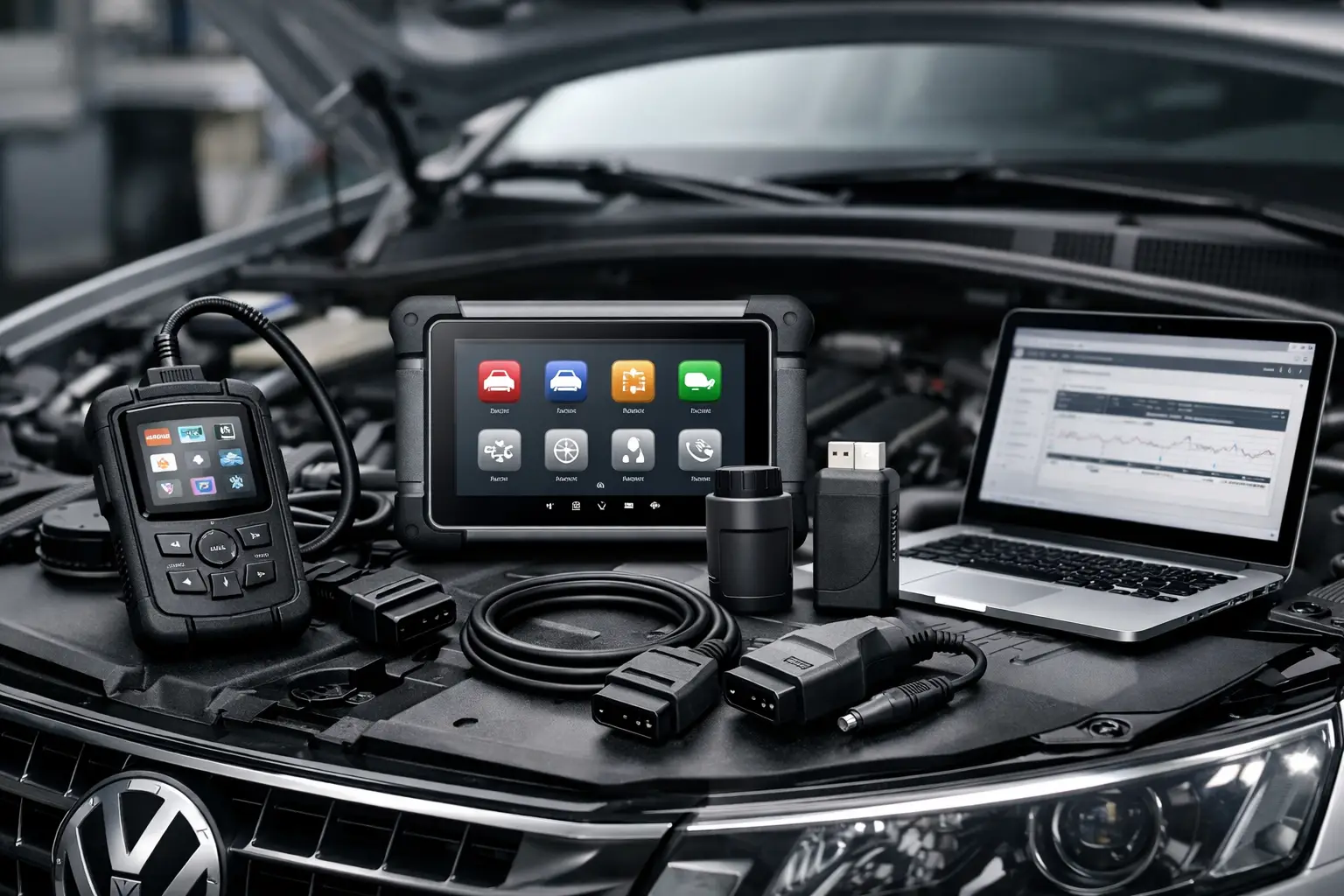
A warning light on a VW Golf or Audi A4 rarely tells the full story. If you want accurate fault-finding on a modern Volkswagen Audi Group car, the best VAG diagnostic tools do far more than read a generic engine code. They need to talk properly to the car’s control modules, access manufacturer-specific data and, in some cases, support coding, adaptations and guided testing.
That matters whether you are an owner trying to understand a recurring fault or deciding where to book the car in locally. For drivers around Aldermaston, Tadley, Basingstoke, Reading and Newbury, it often comes down to one practical question – do you buy a tool for basic checks, or do you put the car in with a VAG specialist who already has the right equipment and experience to interpret the results properly?
What makes the best VAG diagnostic tools different?
A generic OBD reader is fine for a loose sense of what is wrong, but that is not the same as proper diagnostics on an Audi, Volkswagen, Škoda or SEAT. VAG vehicles use multiple control units that communicate across different systems, and many faults sit outside the engine ECU. DSG gearbox issues, Haldex faults, parking brake problems, body control faults and intermittent electrical issues can all require access beyond what a basic handheld reader can offer.
The best VAG diagnostic tools typically give you full module scans, live data, service functions and access to fault code descriptions that actually mean something in the context of the car. Better tools also allow coding and adaptation, but that is where experience matters. Having the function available does not mean it should be used casually.
1. ODIS – closest to dealer-level VAG diagnostics
If you want the benchmark, ODIS is the factory-style platform used in dealer environments and specialist workshops. It is built around deep access to VAG systems and is the right choice when advanced fault-finding, software procedures and guided diagnostics are needed.
For workshop use, it is hard to beat. For private owners, it is usually unrealistic. Setup can be awkward, costs can be high and there is a learning curve. It is also not the sort of system most people want to keep on hand just to check why an engine management light has appeared on the school run.
Where it stands out is on more involved jobs. If you are asking where to get an Audi DSG service or where to investigate a mechatronic fault properly, this level of tooling is part of the answer. The tool matters, but so does the technician using it.
2. VCDS – still one of the best VAG diagnostic tools for enthusiasts
VCDS has been a favourite in the VAG world for years, and for good reason. It offers broad access to VAG modules, reliable fault scanning, live data, service resets and plenty of coding and adaptation capability. For independent specialists and serious owners, it remains one of the best all-round options.
It is especially useful if you own older or mid-generation VAG models and want more than a basic code reader. You can do a full vehicle scan, check measuring blocks and carry out many service-related tasks.
The trade-off is that it still expects a degree of confidence. It is not aimed at complete beginners, and there is plenty of scope to misinterpret data or make changes you did not mean to make. As a diagnostic platform, it is strong. As a substitute for workshop experience, it is not.
3. OBDeleven – convenient for owners, with some limitations
OBDeleven has become popular because it is accessible. It works well for owners who want something more capable than a cheap scanner but without the bulk of a laptop-based setup. On many VAG models, it can read and clear codes, access live data and carry out selected coding or service functions.
Its convenience is the main selling point. For a quick health check on the driveway, it is useful. For enthusiasts, it can also be handy for small tweaks.
The limitation is depth and consistency compared with more established workshop-grade systems. It can be very effective in the right hands, but for complex intermittent faults, drivetrain concerns or gearbox issues, it is not where most specialists would stop. It is a good ownership tool, not a replacement for proper diagnostic investigation.
4. Snap-on diagnostic platforms – strong in the workshop, broader than VAG only
Snap-on diagnostic systems are widely used in independent garages and can be very capable on VAG vehicles. They often combine good graphing, guided tests and broad vehicle coverage, which suits workshops that see many different manufacturers.
That broad coverage is both a strength and a weakness. If your workshop handles everything from Ford to BMW to Volkswagen, it makes sense. If your entire focus is VAG, there are usually more brand-specific options that go deeper.
For local drivers, this is where workshop choice matters. A garage may have an expensive scanner, but if it is a generalist tool used across dozens of brands, that is not always the same as using VAG-focused equipment alongside technicians who know common platform faults.
5. Autel – capable and improving fast
Autel has moved on considerably over the years. Higher-end Autel units now offer strong coverage, useful topology mapping, service functions and a practical interface that many workshops like. On VAG cars, they can be very useful for diagnostics, maintenance functions and system checks.
They are often good value for the level of coverage offered, especially for independent garages. For some jobs, they are more than enough. For the deepest VAG-specific procedures, however, most specialists still pair them with more dedicated software.
So if you are comparing tools on paper, Autel can look like the best buy. In practice, the right answer depends on the job. Reading a stored ABS fault is one thing. Diagnosing a recurring communication issue across multiple modules is another.
6. Launch – practical and cost-effective for mixed workshops
Launch tools sit in a similar category. They cover a huge number of vehicles, offer good functionality for the money and can be very helpful in day-to-day garage work. For servicing and routine fault code work on VAG cars, they are often perfectly serviceable.
The question is less about whether they work and more about whether they are the best option for serious VAG fault-finding. Usually, they are part of the toolkit rather than the whole answer. A specialist workshop may use a Launch unit for some tasks, but still rely on VAG-specific platforms when the diagnosis gets more technical.
7. Basic handheld OBD tools – useful, but easy to outgrow
Cheap handheld scanners have their place. If you want to know whether the engine light is linked to a misfire, emissions issue or sensor fault, they can be helpful. They are small, quick and inexpensive.
But they are not among the best VAG diagnostic tools if your aim is proper diagnosis. They generally cannot see enough of the car, and they miss the manufacturer-specific detail that often points to the real fault. On modern VAG vehicles, that gap becomes obvious very quickly.
Which tool is right for you?
If you are a VAG owner who likes to stay informed, an owner-level tool such as OBDeleven or VCDS may make sense. They can help you monitor faults, prepare for a workshop visit and avoid guessing. That is especially useful if you run an older Audi, VW, Škoda or SEAT and want better visibility into common issues.
If you are trying to solve a persistent fault, though, buying a tool is not always the cheapest route. Many owners spend money on scanners, then still need a specialist to interpret the results. A fault code is only the starting point. The real value lies in understanding whether the issue is a sensor, wiring, software behaviour, mechanical wear or a symptom of something else.
That is why local drivers often choose a workshop with proper VAG capability instead. Around Aldermaston, Tadley, Basingstoke, Reading and Newbury, convenience matters, but so does accuracy. If the car is your daily transport, you need the job diagnosed properly, not just the warning light cleared.
For gearbox concerns, drivetrain faults, recurring warning lights or poor running, specialist knowledge becomes even more important. The same is true if you need help with service work linked to diagnostics, such as DSG servicing, Haldex servicing or investigating mechatronic issues. In those cases, dealer-level thinking without dealer pricing is often the better route than trying to piece things together at home.
Best VAG diagnostic tools for owners versus specialists
For owners, the sweet spot is usually a tool that can scan all modules, provide readable fault descriptions and offer some useful live data. Anything beyond that is a bonus.
For specialists, the standard is different. They need reliable communication across systems, advanced functions, coding and adaptation capability, and enough VAG experience to know what normal looks like on these platforms. That combination matters far more than a flashy screen or a long list of supported brands.
If you are choosing a garage rather than a scanner, ask the simple questions. Do they work on VAG cars regularly? Do they understand common faults on DSG, Haldex and mechatronic systems? Are they using modern diagnostic equipment and quality parts? Those answers usually tell you more than the brand name on the scan tool.
A good diagnostic tool can save time and money. The right workshop can save a lot more than that, because accurate diagnosis prevents parts being fitted on guesswork. For VAG owners, that is often the difference between a quick fix and an expensive detour.
If your Audi, Volkswagen, Škoda or SEAT is showing warning lights, shifting poorly or developing an intermittent fault, the smartest next step is not always buying another gadget. Sometimes it is getting the car in front of the right people, close enough to be practical and specialised enough to get to the bottom of it properly.