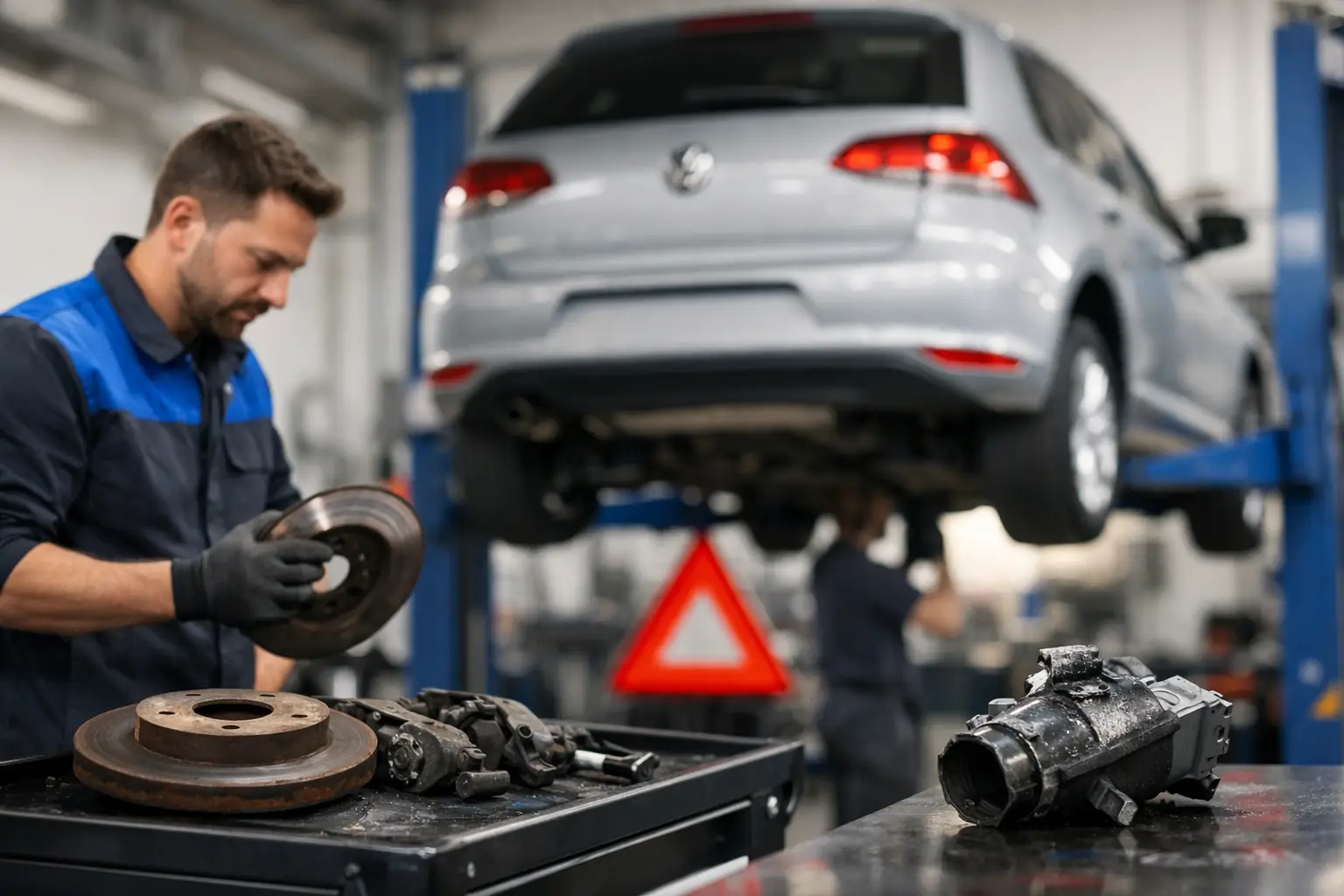
A failed MOT usually comes at the worst possible time – just before the school run, a commute into Reading, or a week when you could really do without an unexpected garage bill. This Volkswagen MOT fail repairs guide is here to make that next step clearer. If your VW has failed, the key is not to panic, not to guess, and not to throw parts at the problem without proper checks.
Volkswagens are generally well engineered, but they are not immune to the same wear-and-tear items that catch many cars out at test time. The difference is that some failures are simple and inexpensive, while others need brand-aware diagnostics to avoid wasting money. That matters if you rely on your car daily and want it fixed properly first time.
Volkswagen MOT fail repairs guide – what to do first
The MOT failure sheet tells you what has failed, but it does not always tell you why. That distinction matters. A warning light, uneven braking result, or emissions failure can all have more than one root cause.
Start by separating the issues into three groups: safety-critical faults, legal test failures, and advisories that can wait a little longer. Tyres with cords showing, severely worn brakes, broken suspension components, or major lighting faults need immediate attention. Other items, such as a marginal emissions reading or minor wear noted as an advisory previously, may be more straightforward once the underlying cause is confirmed.
If you are driving in from Aldermaston, Tadley, Basingstoke, Newbury or Reading, it is worth choosing a workshop that knows Volkswagen systems rather than treating the car like a generic hatchback. Modern VWs often need fault-code analysis, live data checks and experience of common platform issues before the correct repair becomes obvious.
The most common reasons a Volkswagen fails its MOT
Tyres, brakes and suspension wear
These are still the big three. Uneven tyre wear can be caused by alignment issues, tired suspension arms, damaged springs or neglected maintenance. Replacing tyres alone may get you through a retest, but if the inner edges are worn because of worn suspension components, the new set will not last as they should.
Brake failures are similar. A Volkswagen may fail on worn pads and discs, but it may also fail because a sticking caliper, seized slider or weak rear braking performance is affecting the result. On some models, electronic parking brake systems add another layer. The repair needs to deal with the actual cause, not just the obvious symptom.
Suspension faults often show up as broken coil springs, worn bushes, tired drop links or leaking dampers. These can start as minor knocks and become an MOT issue later. Left too long, they also affect tyre wear and handling.
Lights, visibility and electrical faults
A failed bulb is simple enough, but many Volkswagen MOT fails involve more than just changing a lamp. Moisture in a light unit, wiring faults, failed level sensors or dashboard warning lights can all affect the result. Wiper performance, washer operation and windscreen damage also come up regularly, especially after winter driving.
If the car has multiple warning lights on, that is where proper diagnostics earn their keep. On VAG vehicles, one stored fault can trigger related system warnings, and guessing gets expensive quickly.
Emissions and engine management issues
Emissions failures can be the most frustrating because they are not always visible in normal driving. A Volkswagen might seem to run fine but still fail due to a sensor fault, poor combustion, intake contamination, an exhaust leak, or a catalyst issue.
Diesel models often bring DPF and EGR concerns into the picture. Petrol models can suffer from misfires, lambda sensor faults and carbon build-up. Some engines are more prone than others, particularly if the car has done lots of short trips and rarely gets fully up to temperature.
This is one area where an accurate diagnosis saves money. Replacing sensors without testing is rarely the cheapest route in the end.
When a cheap MOT repair is a false economy
It is understandable to want the least expensive fix after a fail. Sometimes that is exactly the right answer. If the issue is a bulb, a pair of tyres, or front brake pads caught in time, there is no reason to complicate it.
But there are cases where the cheapest quote is only cheap because the inspection has been shallow. Fitting one suspension arm when the opposite side is equally worn may get the car through today, but it does not give you much confidence for the next few months. Replacing a failed coil spring without checking top mounts, dampers and tyre wear patterns can lead to repeat visits.
Volkswagen owners often keep their cars for the long term, so it makes sense to repair with a view to reliability, not just the certificate. OEM or equivalent quality parts matter here. Poor-quality components can create noise, warning lights or premature wear that sends you back into the workshop sooner than expected.
Volkswagen MOT fail repairs guide – where diagnostics matter most
Not every MOT failure needs advanced testing, but some definitely do. If your Volkswagen has failed for ABS, airbag, engine management or emissions-related reasons, diagnostics should be part of the plan from the start.
This is especially true on newer VW models with interconnected control modules and more complex fault monitoring. A dashboard light may point to one system, while the real issue sits elsewhere. The right diagnostic equipment, combined with experience of VAG vehicles, helps identify whether the repair is a sensor, wiring issue, actuator fault, software-related problem or a mechanical defect causing an electronic symptom.
That matters for local drivers who cannot afford repeated downtime. If your car is needed for commuting between Basingstoke and Reading or for everyday family use around Tadley and Newbury, a correct first-time repair is worth more than a quick guess.
How repair priorities should be decided
A sensible workshop should help you prioritise rather than simply hand over a long estimate. The first priority is anything that makes the car unsafe or not road legal. The second is anything likely to cause additional damage if delayed. The third is the work that can reasonably be planned in.
For example, a split tyre, heavily worn brakes or a broken spring moves to the top of the list. An oil mist advisory or early-stage bush wear may be worth scheduling alongside future service work. If the car has failed on several items, combining repairs can also reduce repeat labour and make better use of workshop time.
There is always a balance between ideal and realistic. Some owners want everything put right at once. Others need the car back on the road with the essential failures addressed first. A good garage should be honest about both options.
What local Volkswagen owners should expect from a proper repair
A proper MOT repair is not just about passing the retest. You should expect clear fault confirmation, an explanation in plain English, and parts that are suitable for the vehicle rather than whatever is cheapest on the shelf.
For Volkswagen models, that often means using OEM or equivalent quality parts and carrying out repairs with the correct procedures and tools. Electronic parking brakes, service resets, fault memory checks and calibration requirements can all be relevant depending on the model and the work involved.
This is where a VAG specialist workshop can make life easier. If you are based near Aldermaston, the wider Tadley area, or travelling in from Newbury, Reading or Basingstoke, using a local specialist can offer the technical standard many people associate with a main dealer but with a more personal approach and better value.
With over 30 years of VAG experience, modern diagnostic equipment and a practical understanding of common Volkswagen issues, Mechalex is set up for exactly this kind of work – from straightforward MOT repairs to the more involved fault-finding that catches many general garages out.
A note on costs and expectations
There is no honest fixed price for every Volkswagen MOT fail because costs depend on the exact model, fault, parts quality and how much diagnosis is needed. A bulb or wiper issue is very different from a suspension refresh or emissions investigation.
The best approach is transparency. You should know what has definitely failed, what is recommended, what can wait, and where there are options. Sometimes an older vehicle may not justify every advisory being tackled immediately. In other cases, doing the extra work now prevents a much larger bill later.
That is why repair advice should be based on condition and intended use, not pressure. A car doing heavy weekly mileage needs a different plan from one that only covers local errands.
If your Volkswagen has failed its MOT, the most useful next step is a calm, accurate assessment by people who know the brand. Once the real cause is identified, the repair plan usually becomes much simpler than the fail sheet first makes it seem.