
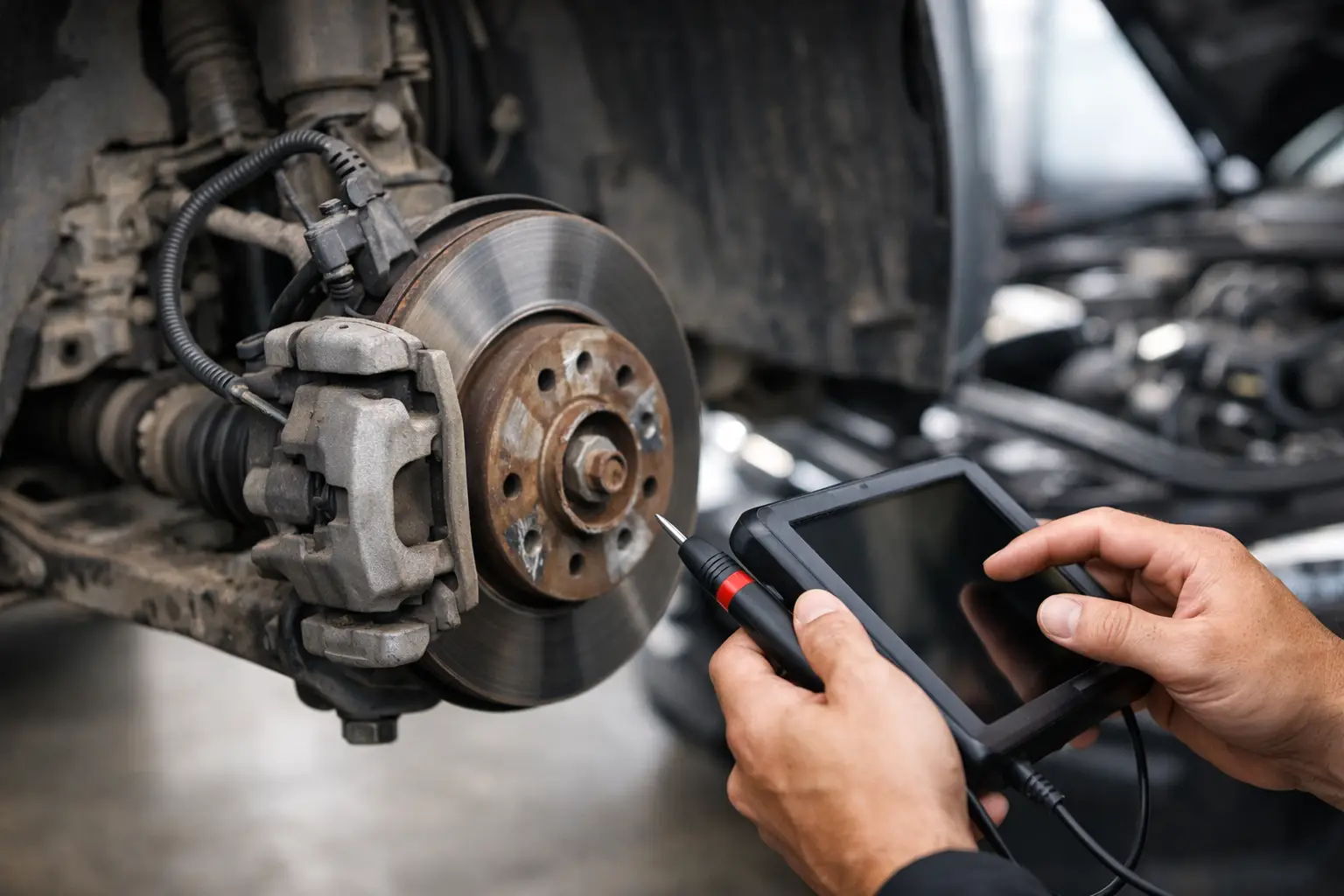
An ABS warning light that appears once on a wet morning and then disappears is easy to ignore. One that stays on needs proper attention, because ABS faults are rarely fixed by guesswork and they can affect braking performance, stability systems and MOT outcomes. If you want to know how to diagnose ABS faults properly, the key is to work methodically rather than replacing parts based on suspicion.
On Audi, Volkswagen, Škoda and SEAT models in particular, the ABS system is tied into several other control systems. A single fault can trigger warning lights for ABS, traction control, ESC and sometimes tyre pressure monitoring depending on the platform. That is why a quick code read is useful, but it is only the start.
How to diagnose ABS faults without wasting money
The first step is to confirm the complaint properly. Is the ABS light on all the time, only after driving off, or only during wet weather? Does the speedometer behave oddly? Are there any steering angle, traction control or parking brake warnings alongside it? Those details matter because they help separate a wheel speed sensor issue from a voltage problem, wiring fault or internal hydraulic unit failure.
A lot of ABS faults present in similar ways from the driver’s seat. The warning light is on, braking feels normal in everyday use, and there may be no obvious symptoms until a hard stop or slippery road. That does not mean the cause is minor. It simply means the base braking system still works while the anti-lock function is disabled.
A proper diagnosis usually starts with a full vehicle scan using suitable diagnostic equipment. On VAG vehicles, brand-aware diagnostics are particularly important because they give access to manufacturer-specific fault descriptions, live data and coding information that generic tools can miss or oversimplify. A code such as intermittent wheel speed signal, implausible signal or pump motor electrical fault points you in the right direction, but it does not automatically identify the failed part.
Start with the basics before blaming the ABS module
Battery voltage is often overlooked. Low system voltage can cause a surprising range of ABS and stability control faults, especially on modern cars with multiple control units talking to each other. If the battery is weak or the charging system is inconsistent, you can end up chasing false faults.
Tyre sizes and wheel fitment should also be checked. Mismatched rolling radius from incorrect tyres can produce speed comparison issues. It is not the most common cause, but it does happen, particularly after budget tyre replacements or wheel swaps.
Then there is the simple visual inspection. Damaged sensor wiring, corrosion in connectors, broken reluctor rings and heavy rust build-up around hub assemblies are all common triggers. On some vehicles the issue is not the sensor itself but the wheel bearing or magnetic encoder ring built into it. If that encoder becomes damaged or contaminated, the sensor reads poorly even though the sensor tests fine on paper.
This is one reason part-swapping gets expensive. Fitting a new sensor to a faulty bearing or damaged wiring loom rarely solves anything.
Reading fault codes in context
Fault codes need context. A stored code for front left wheel speed sensor does not always mean the front left sensor has failed. It may mean the control unit is unhappy with the signal from that corner. The actual cause could be sensor air gap, wiring resistance, connector corrosion, bearing movement or a damaged encoder ring.
Live data is where diagnosis becomes more accurate. Comparing wheel speed readings while driving at low speed can reveal a sensor dropping out, reporting an erratic speed or lagging behind the others. Many faults only show up once the vehicle is moving, so static testing in the workshop has limits.
If one wheel reads zero intermittently while the others track normally, that corner becomes the focus. If all readings are present but the module logs a pump or valve fault, attention shifts towards the hydraulic unit or control module.
Common ABS faults on Audi, VW, Škoda and SEAT models
Across VAG vehicles, wheel speed sensor faults are common, but they are not the whole story. Wiring issues near suspension components are frequent because those areas see constant movement, water spray and road dirt. Older vehicles can suffer corrosion in connectors or broken wiring hidden inside the insulation.
ABS pump and module faults also appear on some platforms, particularly as cars age. Sometimes the control module develops internal electronic faults. Sometimes the pump motor itself is the issue. In other cases, a previous low voltage event has triggered multiple stored faults and the system needs proper testing before any parts decision is made.
Steering angle sensor faults can also be confused with ABS problems because the systems are linked. After alignment work, battery disconnection or suspension repairs, a steering angle sensor may need recalibration. If that has not been done, warning lights can remain even though the wheel speed side of the ABS system is fine.
Brake light switch faults are another example. On certain cars, an implausible brake pedal signal can interfere with stability system operation and trigger dashboard warnings that look like an ABS issue to the driver.
Testing the wiring and sensor circuit
Once a likely corner or circuit has been identified, electrical testing matters. This can include checking power supply, earth continuity, signal integrity and wiring resistance from the sensor back to the module. The method depends on the type of sensor fitted, because older passive sensors and newer active sensors behave differently.
This is where experience pays off. Testing active sensors incorrectly can lead to misleading results. Equally, checking continuity alone is not always enough because a wire can pass a simple test yet fail under movement or load. In some cases, a wiggle test while monitoring live data will reveal an intermittent break that a static meter check will not.
If the car has recently had wheel bearing, suspension or brake work, look closely at that area first. It is not unusual for sensor wiring to be strained during repairs or for an encoder to be damaged during bearing installation.
When the fault is not the sensor
If sensor signals and wiring check out, the focus may move to the ABS hydraulic control unit. That can be a more involved diagnosis because you need to verify whether the unit is failing internally, losing communication, or reacting to an upstream issue such as low voltage or network faults.
Coding also matters on some VAG systems. If a module has been replaced previously and coded incorrectly, the car may log persistent faults or disable functions. Used modules can create further complications if they are incompatible or still tied to another vehicle configuration.
This is why the cheapest route is not always the lowest final bill. A second-hand module fitted on a hunch can turn one ABS fault into several.
How to diagnose ABS faults after the warning light clears
Intermittent ABS faults are often the most frustrating because the warning light may disappear before the car reaches the workshop. Even so, stored history and freeze-frame data can still tell a useful story. Road testing with live data logging is often the best way to catch a signal drop or communication issue in real conditions.
Weather can be a clue. If the fault appears after heavy rain, moisture ingress in a connector or module plug becomes more likely. If it happens after hitting potholes or over rough roads, wiring movement or bearing play deserves attention.
For local drivers around Aldermaston, Tadley, Basingstoke, Reading and Newbury, that matters because many cars spend their time on mixed roads – motorways, town driving and poorer rural surfaces. Intermittent faults often show themselves in exactly those day-to-day conditions rather than when the vehicle is standing still in a car park.
Why proper ABS diagnosis matters
ABS faults are not just about getting a warning light turned off. The anti-lock system supports vehicle control under heavy braking, and on many cars it works closely with traction and stability systems. Diagnosing the root cause properly protects both safety and cost.
For VAG owners, there is also a practical point. These systems can be platform-specific, and a workshop familiar with Audi, Volkswagen, Škoda and SEAT diagnostics will usually get to the answer faster than one relying on generic code descriptions. Access to the right equipment helps, but so does knowing the common fault patterns across the range.
At Mechalex, that approach is straightforward: confirm the complaint, scan the system properly, test the suspect circuit or component, and only then recommend repair. That is how you avoid paying for parts that were never faulty in the first place.
If your ABS light is on, the best next step is not to clear the code and hope for the best. Get it checked while the fault data is still present, because the right diagnosis is nearly always quicker and cheaper than a chain of educated guesses. A good workshop should be able to explain what has failed, what has been tested and why the recommended repair makes sense.