
That sinking feeling usually starts with a service reminder, a stamped history that goes quiet on a key year, or a new-to-you Audi with a timing belt interval you cannot verify. The timing belt is not a “see how it goes” item. On the wrong day, it can turn a perfectly healthy engine into a very expensive one.
So what is a realistic audi timing belt replacement cost in the UK, and why do quotes vary so much? The honest answer is: it depends on the engine, the access, what’s included in the job, and whether you choose to do the related items properly while the front of the car is apart.
Audi timing belt replacement cost: typical UK ranges
Most customers want a number before anything else. For many belt-driven Audi engines, you will generally see timing belt replacement priced somewhere in the mid hundreds to around four figures. That range is wide because “Audi” covers everything from older, simpler layouts to modern, tightly packaged engines where access time dominates.
As a rough guide, you might expect:
- Smaller, simpler belt-driven engines to land towards the lower end, where access is straightforward and parts kits are widely available.
- Larger engines and tighter engine bays to sit higher, because labour time climbs quickly.
- Jobs that include a water pump, thermostat and coolant to cost more upfront, but often save money over the next few years.
If you are comparing quotes, treat an unusually low figure as a prompt to ask what has been left out, rather than a bargain you have to grab.
Why the price varies so much between Audis
Two Audis can share a badge and a year plate and still be very different underneath. Timing belt work is priced on time, risk, and what the workshop is committing to replace.
Engine type and packaging
The same “timing belt replacement” can mean an easy front-end service position on one model, and a significantly more involved strip-down on another. Labour hours are the main driver once you move beyond the simplest layouts. Some engines have limited clearance, extra ancillary components in the way, or more complex belt routing.
What’s included in the kit
A proper timing belt job is rarely just a belt.
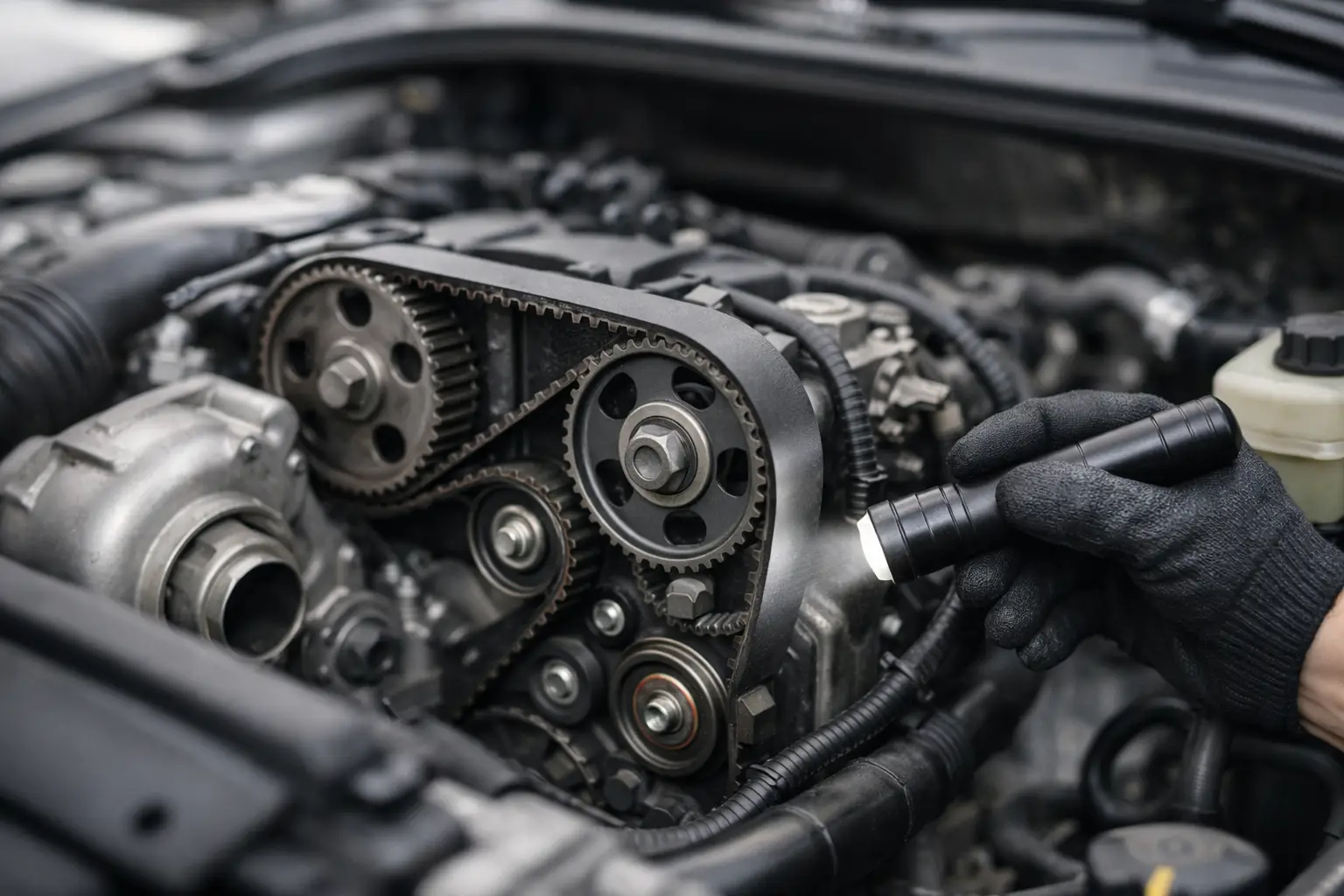
At minimum, you are normally looking at the belt and the tensioning components. On many engines, the idlers and tensioner are as important as the belt itself – if one of those fails, the belt can jump timing even if the belt looks “fine”.
Water pump and coolant: the common turning point
A lot of the cost conversation comes down to the water pump. On many VAG belt-driven engines, the pump is driven by the timing belt, and sits in the same area. If the pump is starting to seep, its bearings are noisy, or it fails later, you can end up paying a large chunk of the labour again.
Replacing the pump while you are there is often the sensible call, but it does change the headline price – and it should, because you are fitting more parts and taking responsibility for a larger section of the system.
OEM or equivalent parts standards
Parts quality matters. Cheap kits exist, but the timing belt system is not where you want unknown provenance. A workshop quoting with OEM or equivalent components is not directly comparable with a quote built around the lowest-cost aftermarket parts.
“While we’re in there” items
This is where good advice can save money, and bad advice can inflate a bill.
Depending on the engine and mileage, it can be sensible to address items that are only accessible during belt work, such as certain seals, auxiliary belt components, or a thermostat. On the other hand, not every engine needs every extra. The best approach is condition-led: inspect, advise, and only replace what has a clear reason.
What a proper timing belt replacement should include
If you are trying to compare like with like, focus on what the job covers, not just the final figure.
A thorough belt replacement normally includes the correct locking and timing procedure, replacement of the belt and tensioning hardware, correct torque settings, and a final verification that the timing is spot-on. In many cases, it also includes a coolant drain and refill if the water pump is being replaced.
You should also expect a decent workshop to check for related issues while everything is exposed – signs of coolant staining, oil leaks that could contaminate the belt, and wear in auxiliary components.
Timing belt interval: why “it’s probably fine” is a gamble
Audi timing belt intervals vary by engine and year, and there can be both mileage and time limits. Even if you do not do many miles, age still matters. Rubber degrades, and tensioners age too.
If you have no proof of when it was last done, assume it is due and budget accordingly. A belt that has survived this long is not evidence it will survive the next year.
Belt vs chain: avoid paying for the wrong job
Not every Audi has a timing belt. Some engines are chain-driven. Others have a belt, but it is not obvious from a quick glance. Before you request a quote, confirm the engine code or at least the exact model, year and engine size.
This matters because timing chain work is a different job entirely, with a different set of failure symptoms and cost drivers. If you are unsure, a VAG specialist can confirm what your engine uses and what the correct service approach is.
Common questions that change the final price
A quote can swing by a couple of hundred pounds based on a few practical details.
Can you provide the parts?
Some workshops will fit customer-supplied parts, others will not. Even when it is offered, understand what happens if the kit is incomplete, incorrect for the engine code, or fails early. The cheapest kit is not cheap if it adds delays and removes accountability.
Do you need a courtesy car?
If you rely on your car for commuting or school runs, downtime is part of the “cost”. Ask about courtesy cars when you book, not the day before, because availability can be limited.
Is the car modified?
Most modifications are not an issue, but they can affect access, undertrays, or the time required to work cleanly and safely. A straightforward note to the workshop helps avoid surprises.
How to keep the cost sensible without cutting corners
If you want the job done properly and you still want value, focus on three things.
First, make sure the quote is clear on what is being replaced: belt, tensioner, idlers, water pump, thermostat, coolant. Second, ask whether the workshop is using OEM or equivalent quality parts and the correct timing tools for your engine. Third, do not delay once it is due – the cheapest timing belt replacement is the one you do before anything fails.
A good independent specialist should be able to explain the options in plain English, including when it is worth doing the pump and when it is reasonable to leave certain extras alone.
Choosing a workshop: what matters for timing belt work
Timing belt replacement is routine for a VAG specialist, but it is not “basic”. Accuracy matters, and so does attention to detail.
Look for a workshop that does these jobs regularly, uses the correct diagnostic equipment and timing tools, and is comfortable working to manufacturer procedures. Ask how they verify timing once the new belt is fitted, and whether they check for coolant or oil contamination risks.
If you are local to Aldermaston and the wider Tadley, Basingstoke, Reading or Newbury area and want dealer-grade capability without the dealer price structure, Mechalex can advise on the right timing belt interval for your specific Audi and quote the job based on the exact engine code and what’s sensible to replace – details at https://www.mechalex.co.uk.
The cost you do not see: what happens if you leave it too long
It is worth being direct about this: timing belt failure is usually not a recovery-and-carry-on scenario. On many Audi engines, a snapped belt or failed tensioner can allow pistons and valves to meet. That can mean cylinder head work, new valves, potentially piston damage, and a repair bill that dwarfs the cost of preventative maintenance.
Even if it does not fail catastrophically, a belt that has degraded or a tensioner that is not controlling properly can cause timing to drift. That can bring poor running, fault codes, and a lot of diagnostic time spent chasing something that should have been handled at the service interval.
If you are weighing up whether to do it now or later, the best closing thought is simple: treat the timing belt like insurance you can actually control. Get the interval right, choose parts you would trust for the next 5 years, and you will spend your money once – not twice, and not at the roadside.