If your Audi, Volkswagen, Škoda or SEAT feels flat through the mid-range, idles less cleanly than it used to, or has lost some of the sharpness it once had, a walnut blasting service review is worth reading before you book anything. Carbon build-up on direct injection petrol engines is a real issue on many VAG models, but the results of cleaning depend on the engine, the mileage and how heavy the deposits are.
What a walnut blasting service review should actually tell you
A useful review is not just a before-and-after claim about better performance. It should explain what the process is designed to fix, where it works well, and where expectations need to stay realistic.
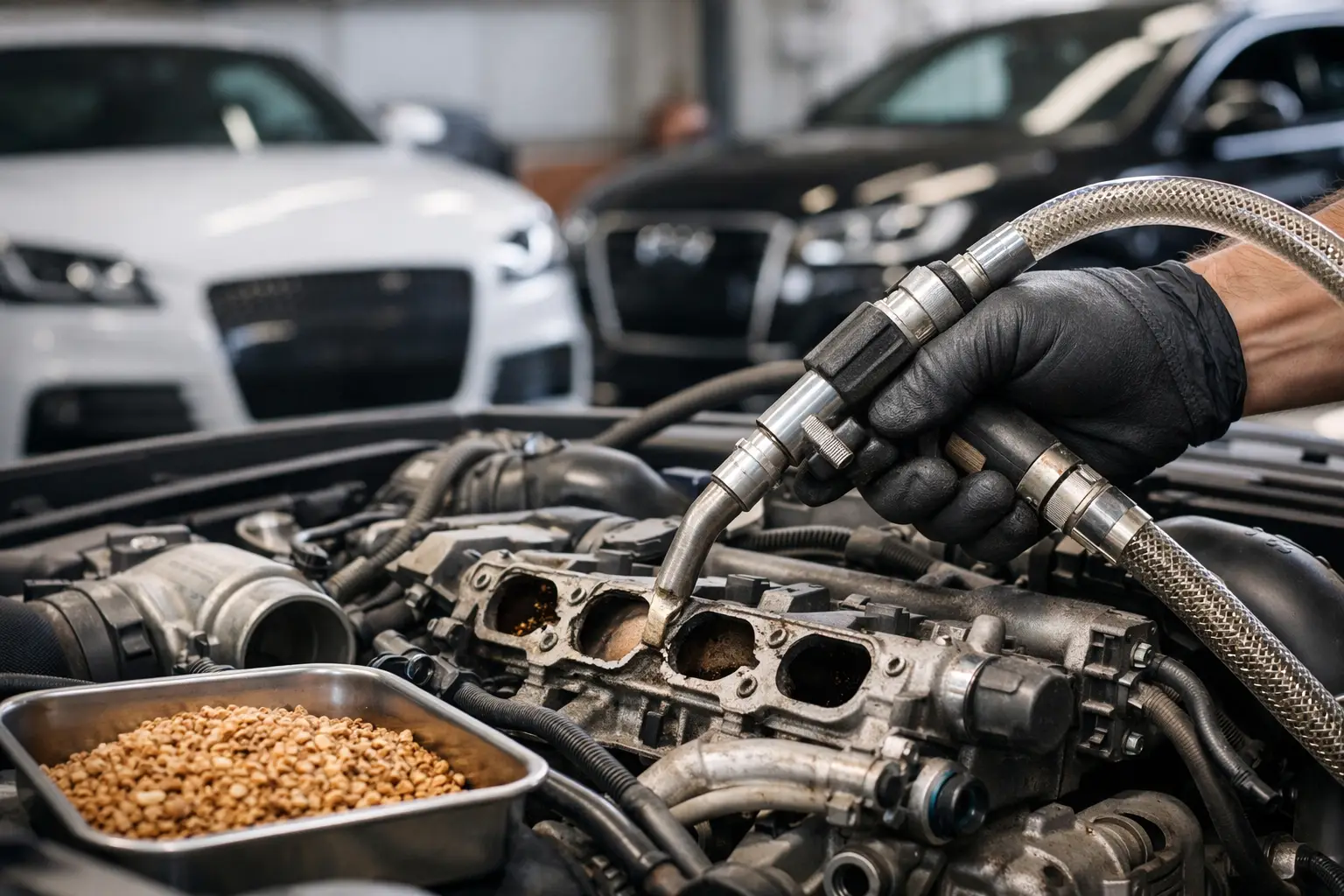
Walnut blasting is a method of cleaning carbon deposits from the intake valves and ports using crushed walnut shell media. On direct injection petrol engines, fuel does not wash over the back of the intake valves in the same way it does on older port-injected setups. Over time, oily vapours and combustion by-products can leave heavy deposits behind. Once that build-up becomes significant, airflow is disturbed and engine behaviour can suffer.
A proper review should also make clear that walnut blasting is not a miracle cure for every running issue. If a car has ignition faults, boost leaks, injector problems, timing issues or PCV-related faults, carbon cleaning may help only part of the problem – or not at all. That is why diagnosis matters before any parts are removed.
When walnut blasting is worth considering
For many VAG owners, the strongest case for walnut blasting is a gradual decline rather than a sudden failure. The car still runs, but not as cleanly or as eagerly as it should.
Common signs include hesitant throttle response, uneven idle, reduced fuel economy, misfires at idle or under light load, and a general feeling that the engine is working harder than it ought to. Some drivers notice it most during overtaking or motorway slip road acceleration. Enthusiasts often spot it earlier, because they know how the car used to pull.
This is particularly relevant on turbocharged direct injection petrol engines found across Audi, VW, Škoda and SEAT ranges. Not every engine suffers to the same degree, and driving style plays a part, but carbon build-up is common enough that it should be on the radar for owners keeping their cars long term.
Mileage is only part of the picture. One engine can be heavily coked up at 50,000 miles while another is relatively moderate at 80,000. Short journeys, stop-start use and oil vapour management can all influence the rate of build-up.
Walnut blasting service review – the results you can realistically expect
The best walnut blasting service review is an honest one. In a car with clear intake valve contamination, the improvement can be noticeable. Idle quality often smooths out, throttle response becomes crisper and the engine may feel more willing through the rev range.
That said, the result is not always dramatic in a seat-of-the-pants sense. If the deposits were moderate rather than severe, you may notice the engine feels cleaner and more consistent rather than suddenly faster. That still matters. Restoring lost efficiency and drivability is often the real benefit.
On cars that have been running poorly for some time due to heavy carbon build-up, the difference can be much more obvious. Owners sometimes report easier cold starts, less lumpiness at idle and stronger pickup from lower revs. The more compromised the airflow was beforehand, the more obvious the gain tends to be.
The trade-off is cost and labour. Walnut blasting is not a quick aerosol treatment poured into the intake. It requires dismantling, access to the intake ports and proper workshop procedure. Done properly, it is a specialist job rather than a cheap add-on.
Why the quality of the workshop matters
This is where reviews often miss the most important point. The process itself is only half the story. The other half is whether the workshop understands VAG engines, knows what else to inspect while the intake is apart and can spot if carbon build-up is only one part of the issue.
A specialist workshop should be comfortable dealing with Audi, Volkswagen, Škoda and SEAT engines on a regular basis. That matters because common VAG patterns are easier to recognise when the technicians see them every week rather than every few months. If there are related faults, vacuum issues, PCV concerns or signs of wear elsewhere, they are more likely to be picked up before the car goes back together.
For drivers around Aldermaston, Tadley, Basingstoke, Reading and Newbury, there is also the practical side. A local specialist with proper diagnostic capability is often a better fit than travelling further for a generic carbon clean. Convenience matters when the car is part of your daily routine, especially if you rely on it for commuting, school runs or business use.
What happens during the job
The intake manifold is removed to gain access to the intake ports and valves. Each cylinder is positioned appropriately, and the carbon deposits are cleaned using walnut shell media with extraction equipment. The goal is to remove the built-up contamination without damaging surrounding components.
A proper job also includes checking the condition of what has been removed and reassembled. Gaskets, seals and related fittings should be handled correctly. This is not a place for rushed work, because air leaks or poor reassembly will create fresh problems that did not exist before.
It is also sensible to assess fault codes and live data either side of the work if the vehicle has running concerns. That is the difference between cleaning as a diagnostic dead end and cleaning as part of a proper repair approach.
Is walnut blasting better than chemical carbon cleaning?
For intake valve deposits on direct injection engines, walnut blasting is generally the more effective method. Chemical treatments have their place in maintenance, but they do not usually match the cleaning power of direct mechanical removal when deposits are heavy.
That does not mean chemical products are pointless. In mild cases, or as part of broader maintenance, they may offer some benefit. But if a VAG petrol engine has substantial build-up and the symptoms are established, walnut blasting is usually the more credible answer.
A fair comparison is this: chemical cleaning may help manage or reduce light contamination, while walnut blasting deals with the problem properly when the deposits are physically thick on the valves and ports.
Who benefits most from walnut blasting
Owners planning to keep their car for the long haul usually get the most value from the job. The same goes for drivers who have noticed a decline and want the engine brought back to how it should feel, not simply patched over.
It also makes sense for performance-minded owners. If you have invested in a well-maintained VAG car, or you are considering tuning and want the engine operating from a healthy baseline, cleaning the intake valves can be a sensible step. There is little point asking for the best from an engine that is breathing through heavy deposits.
Where it may be less worthwhile is on a car with no symptoms, uncertain service priorities and other more urgent faults competing for budget. In that case, a good workshop should be honest about what needs doing first.
A balanced walnut blasting service review for local owners
If you own an Audi, VW, Škoda or SEAT in the wider Aldermaston, Tadley, Basingstoke, Reading or Newbury area, walnut blasting is one of those services that makes most sense when it is recommended for the right reason. Not every uneven idle means carbon. Not every tired-feeling engine needs intake cleaning. But when carbon build-up is confirmed, the service can restore drivability and refinement in a way quick-fix products generally cannot.
The strongest reviews tend to come from owners who had a clear problem, had the engine assessed properly and had the work carried out by technicians familiar with VAG platforms. That combination matters more than flashy claims about instant power gains.
With more than 30 years of VAG experience, modern diagnostic equipment and a workshop approach built around doing the job properly, Mechalex is the sort of independent specialist many local owners look for when dealer pricing does not make sense but standards still matter.
If you suspect carbon build-up, the smartest next step is not guessing from symptoms alone. It is having the car inspected by people who know the platform, can diagnose it properly and will tell you plainly whether walnut blasting is the right job for your engine at this stage.