You usually notice it gradually. Throttle response is not quite as sharp, idle quality starts to feel a bit uneven, and the engine seems less eager than it used to. For many direct injection petrol engines, especially across Audi, Volkswagen, Škoda and SEAT ranges, those symptoms often point to one issue – carbon build-up on the intake valves. That is where the walnut blasting carbon cleaning benefits become very real, not just theoretical.
Direct injection has brought clear gains in efficiency and performance, but it also created a known maintenance issue. Because fuel is injected directly into the combustion chamber rather than washing over the intake valves, oil vapour and contaminants from the breather system can collect and bake onto the valve surfaces over time. Once that build-up becomes heavy enough, airflow suffers and drivability can start to change.
What walnut blasting actually does
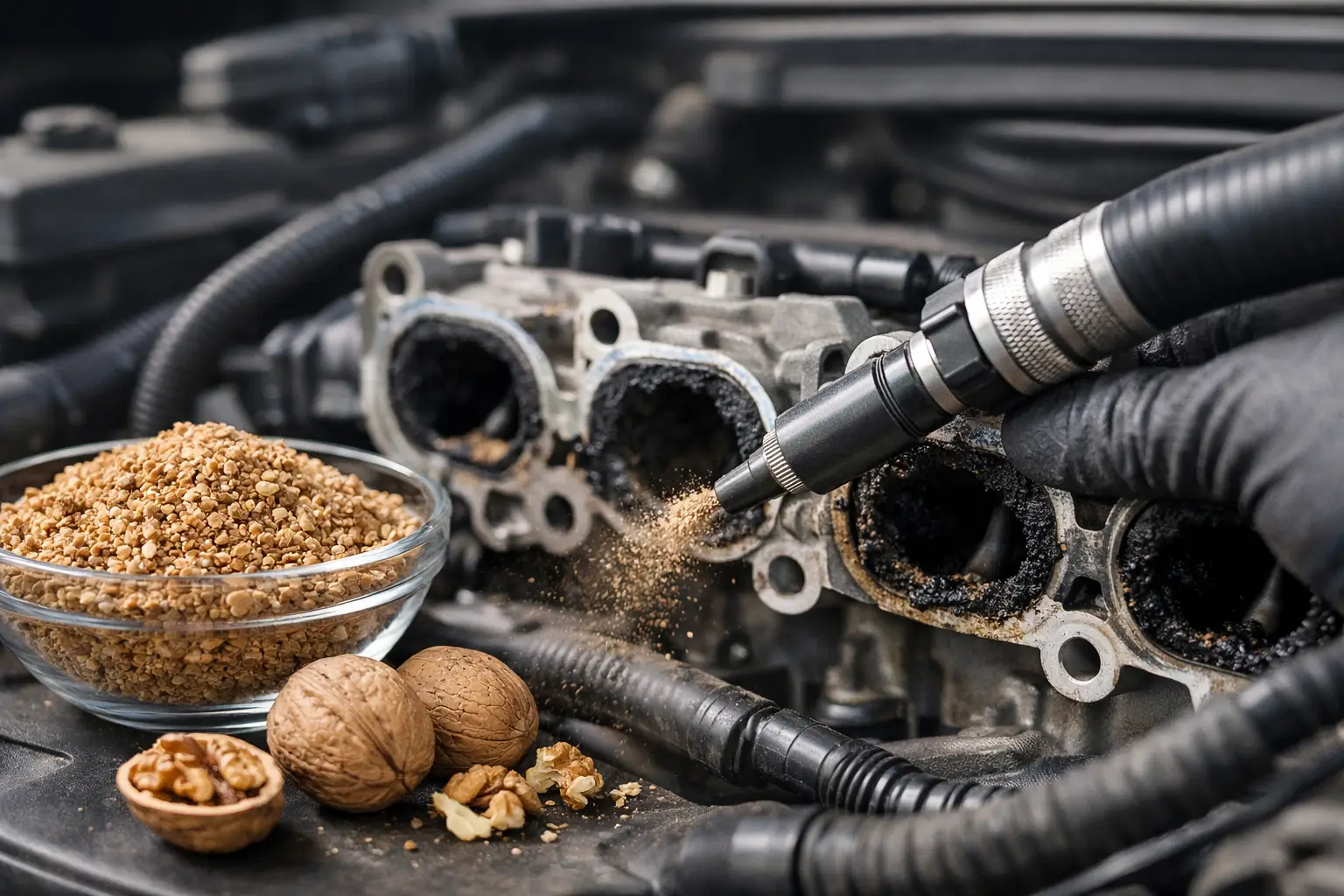
Walnut blasting is a specialist cleaning process used to remove carbon deposits from intake valves and ports. Crushed walnut shell media is blasted into the intake tract with controlled air pressure while the deposits are extracted with suitable vacuum equipment. The shell material is firm enough to remove stubborn carbon, but soft enough not to damage the metal surfaces when the job is carried out correctly.
This is not a cosmetic service. It is a mechanical cleaning process aimed at restoring proper airflow into the engine. On VAG petrol engines with direct injection, that can make a noticeable difference because carbon build-up tends to affect how evenly the engine breathes across cylinders.
The quality of the work matters just as much as the process itself. Access has to be gained properly, the valves need to be positioned correctly, and the cleaning has to be thorough rather than rushed. A partial clean can leave deposits behind and limit the result.
Walnut blasting carbon cleaning benefits in the real world
The biggest benefit is restored airflow. When intake valves are heavily coated, the engine has to work around that restriction. Remove the deposits, and the engine can often return much closer to how it was designed to perform.
That usually shows up first in drivability. The engine may idle more smoothly, respond better to throttle input and pull more cleanly through the rev range. Some drivers describe it as getting the sharpness back. Others simply notice that the car feels less strained in normal day-to-day use.
Another of the main walnut blasting carbon cleaning benefits is improved consistency. Carbon build-up does not always affect every cylinder equally, so one of the problems it can create is uneven running. Once the deposits are cleaned away, the engine often feels more balanced and settled, particularly at idle and under light acceleration.
Fuel economy can also improve, although this is one of those areas where it depends on the condition of the engine before cleaning. If carbon build-up was significant and airflow had been badly affected, there may be a worthwhile gain. If deposits were relatively modest, the difference at the pump may be less dramatic. It is better to think of walnut blasting as restoring lost efficiency rather than creating extra efficiency out of nowhere.
Why VAG direct injection engines are prone to carbon build-up
This issue is especially familiar on many turbocharged direct injection petrol engines used across the Volkswagen Audi Group. That does not mean every engine will suffer to the same degree or at the same mileage, but the pattern is well known enough that specialist workshops see it regularly.
Driving style plays a part. Cars used mainly for short trips, stop-start commuting and colder running conditions may build deposits more quickly than cars that regularly cover longer distances at full operating temperature. Oil quality, service history and the general condition of the breather and intake systems also matter.
Some owners first come in because they have noticed rough idle, hesitation or flat performance. Others discover the issue while chasing a fault code or investigating misfires. In enthusiast circles, walnut blasting is often booked proactively because drivers want to maintain performance before symptoms become more obvious.
The signs your car may need carbon cleaning
There is no single mileage where every car needs it. Some engines show clear symptoms earlier than expected, while others stay reasonably clean for longer. That said, there are common signs worth paying attention to.
A rough or lumpy idle is one of the most frequent. Hesitation on acceleration, reduced throttle response and a feeling that the engine is not pulling as cleanly as it should are also common. On some cars, there may be fault codes linked to misfires or mixture issues. In other cases, the car simply feels tired compared with how it used to drive.
If you own a VAG petrol model and those symptoms are developing without an obvious cause, carbon build-up is worth considering. Proper diagnosis still matters, because ignition faults, vacuum leaks and sensor issues can create similar complaints. The right workshop will not assume walnut blasting is the answer to every drivability problem.
What walnut blasting will and will not fix
This is where a sensible approach matters. Walnut blasting can be very effective when carbon deposits on the intake valves are the root cause of reduced performance, uneven idle or restricted airflow. It can restore what build-up has taken away.
What it will not do is fix unrelated faults. If the issue is a failing coil pack, injector problem, boost leak, PCV fault or timing-related problem, carbon cleaning alone will not solve it. The same applies if the engine has mechanical wear elsewhere. Good diagnostics should come first, especially if there are fault codes or multiple symptoms involved.
It is also worth being realistic about expectations. On a heavily carboned engine, the difference can feel significant. On a lightly affected engine, the improvement may be more subtle. Either way, the benefit is in bringing the engine back towards proper operating condition rather than chasing miracle gains.
Why proper equipment and experience matter
Walnut blasting is straightforward to describe, but doing it properly takes care and experience. Accessing the intake system on modern VAG engines is not always simple, and cleaning has to be carried out methodically to avoid leaving debris where it should not be.
This is one of those jobs where specialist familiarity makes a difference. A workshop used to working on Audi, VW, Škoda and SEAT vehicles will already know the common engine layouts, the typical build-up patterns and the related faults that can appear alongside carbon contamination. That matters because the aim is not just to clean the valves, but to make sure the underlying complaint has been assessed properly.
For owners around Aldermaston, Tadley, Basingstoke, Reading and Newbury, using a VAG specialist such as Mechalex means the car is being checked by technicians who deal with these engines regularly, using the correct process and modern diagnostic equipment.
Is walnut blasting worth it?
If your engine is showing classic symptoms of carbon build-up, it often is. The value comes from improved drivability, restored response and preventing a known issue from continuing to affect how the car runs. For many owners, that makes more sense than living with a car that feels below par or replacing parts blindly in search of a fix.
If your vehicle is running perfectly and there is no evidence of carbon-related issues, the timing becomes more of a judgement call. Enthusiasts often choose to have it done as preventative maintenance, especially on performance-focused cars. Daily drivers may wait until symptoms or inspection results justify the work. Neither approach is wrong – it depends on how the car is used, how sensitive you are to changes in performance and how long you plan to keep it.
For direct injection VAG engines, carbon build-up is not unusual and it is not something to ignore once symptoms appear. When the job is diagnosed properly and carried out to the right standard, walnut blasting is one of the most effective ways to restore lost performance without replacing parts that are not actually faulty.
If your Audi, Volkswagen, Škoda or SEAT feels rougher, flatter or less responsive than it should, carbon build-up may be the reason – and sorting it sooner can make everyday driving feel right again.