If your Audi, Volkswagen, Škoda or SEAT starts feeling a bit different in poor weather, on tight turns or when pulling away, there is a fair chance the four-wheel-drive system needs attention. Haldex service signs explained properly means looking beyond a dashboard warning light, because many cars show symptoms long before the system logs a clear fault.
For a lot of VAG owners, Haldex problems are easy to miss at first. The car still drives, the engine feels fine, and there may be no dramatic noise. But the rear drive engagement can become weak, delayed or inconsistent, and that changes how the vehicle puts its power down. Left too long, what could have been straightforward servicing can turn into pump, coupling or differential-related faults.
What the Haldex system actually does
On many four-wheel-drive VAG models, the Haldex system controls how drive is sent to the rear axle. In normal driving, the car may run mainly through the front wheels, then engage the rear axle when extra traction is needed. That can happen during hard acceleration, on wet roads, when pulling out of junctions or when wheel slip is detected.
Because the system works in the background, most drivers only notice it when it stops working as it should. The car can feel less stable under load, more prone to front wheel spin, or less sure-footed in the conditions where it would normally feel planted.
Different generations of Haldex behave slightly differently, and service requirements can vary by model and year. That matters, because guessing based on a forum post for a different vehicle is often where owners get led in the wrong direction.
Haldex service signs explained: the symptoms owners notice first
The most common sign is a loss of traction from a standstill, especially in the wet. If the front wheels scrabble more easily than they used to, or the car feels like it is no longer getting proper rear axle support, the Haldex system deserves a closer look.
Another frequent clue is hesitation or inconsistency when accelerating out of bends or junctions. Owners often describe it as the car feeling less settled, less sharp or somehow more front-wheel-drive than before. That sounds vague, but in practice it is often accurate.
You may also notice warning messages relating to the drivetrain, ABS, traction control or four-wheel-drive system. Not every Haldex fault produces a simple message saying the coupling has a problem. Sometimes the fault picture is broader, which is why proper diagnostics matter.
Noise can be part of it as well, though it is not always the first symptom. Some cars develop unusual whining, binding sensations on manoeuvres, or clunky behaviour from the rear when the system is not operating correctly. Equally, some faulty systems stay quiet and simply stop delivering the expected traction.
Common warning signs include
A few patterns come up regularly. One is poor grip when pulling away. Another is a fault code stored without an obvious warning on the dash. A third is a service history that shows the Haldex oil has been neglected or the filter and pump screen have not been checked where applicable.
That last point matters more than many people realise. A Haldex unit can degrade gradually, and by the time the car feels clearly wrong, contamination has often been building up for a while.
Why these signs happen
In many cases, the root cause is missed servicing. Haldex oil does not last forever. Over time it degrades and contamination builds up in the system. On some generations, the pump pickup or screen can become restricted. When that happens, the pump cannot move oil properly, pressure control suffers, and rear drive engagement becomes unreliable.
Electrical faults can also play a part. A pump may fail, wiring may corrode, or a control module may register implausible readings. But it is a mistake to assume every Haldex issue means the whole unit needs replacing. Quite often, the right answer depends on whether the problem is mechanical wear, contamination, an electrical issue or simply overdue maintenance.
Driving style can influence wear, but neglect is usually the bigger factor. Cars used for towing, repeated short journeys, enthusiastic driving or regular poor-weather use may expose a weak Haldex system sooner. That does not mean those uses cause failure on their own. More often, they reveal a system that has not been maintained properly.
When it is a service issue and when it is a repair issue
This is where things get important. If the oil is old and the pump screen is restricted but the pump is still healthy, a proper Haldex service may restore correct operation and prevent bigger expense. If the pump has already been overworked for too long, servicing alone may not be enough.
There is no honest one-size-fits-all answer here. Some cars come in with mild symptoms and respond well to maintenance. Others have fault codes, no rear drive engagement and clear evidence of component failure. The longer warning signs are ignored, the more the balance shifts from service to repair.
That is also why changing the oil alone is not always the full story. Depending on the Haldex generation, the condition of the pump, screen, filter arrangement and live data all matter. A quick fluid change without understanding the system can give false confidence.
Haldex service signs explained through proper diagnosis
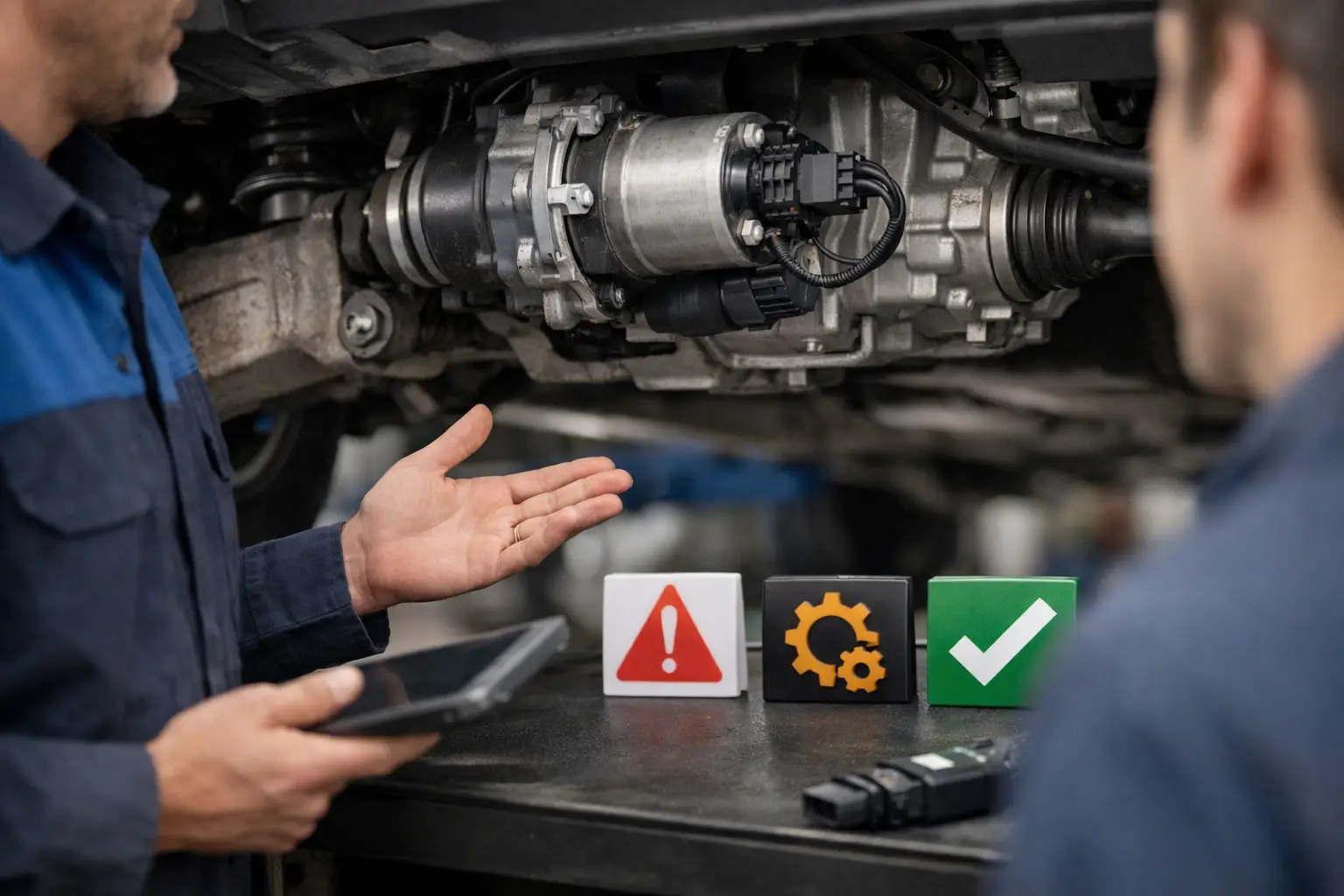
A proper assessment starts with the basics: confirming the exact vehicle, Haldex generation, service history and customer-reported symptoms. From there, diagnostic equipment is used to check for stored faults, look at live readings and test whether the system is being commanded correctly.
Road testing also has its place. A trained technician will often pick up traction behaviour or drivetrain responses that match an underlying Haldex issue. That matters because not every problem can be judged from a warning light alone.
Visual inspection helps too. Oil condition, contamination and the state of related components can tell you a lot. On VAG vehicles, experience counts because the same broad symptom can have more than one cause. A traction complaint might be Haldex-related, but it could also involve tyres, wheel speed sensor faults, ABS system issues or differential-related problems.
What owners should not do
The main thing is not to ignore subtle symptoms just because the car still moves normally day to day. Haldex issues often start small. If you wait for a major warning or complete loss of rear drive, your options may become more expensive.
It is also wise not to rely on generic servicing assumptions. Some independent garages are excellent, but not all see enough VAG four-wheel-drive systems to recognise common patterns quickly. Haldex, DSG and mechatronic-related faults reward specialist knowledge because small details make a big difference.
Cheap fixes can be another false economy. If a car has a blocked pump screen, worn pump or contaminated fluid, simply clearing fault codes or replacing one part without checking the rest of the system may only delay the real repair.
How often should Haldex be serviced?
The safe answer is to follow the correct schedule for the specific model and generation, while recognising that real-world use matters. Some owners benefit from more cautious servicing intervals, especially if the car covers demanding mileage or is kept long term.
If you have bought a used VAG four-wheel-drive car and there is no clear record of Haldex maintenance, it is sensible to have it checked rather than assume it has been done. This is especially true where the vehicle otherwise feels fine. Preventive servicing is usually far cheaper than waiting for a pump or coupling issue to develop.
Why specialist attention makes a difference
Haldex faults sit in that awkward category where the symptoms can seem simple but the correct repair path is not always obvious. You need someone who understands VAG systems, uses proper diagnostic equipment and knows what normal looks like on these vehicles.
That is where a specialist workshop can save time and cost. Instead of treating the issue as a generic four-wheel-drive fault, the job is approached in the context of common VAG platform behaviour, known service needs and model-specific quirks. For owners around Aldermaston, Tadley, Basingstoke, Reading and Newbury, that can mean main dealer standard diagnosis without main dealer pricing.
If your car has started showing the early warning signs, the best next step is simple: get it checked before the problem becomes a larger drivetrain repair. A Haldex system rarely fixes itself, but caught early, it often gives you better options.