A warning light appears on the dash, the car feels different, and the first question is usually: can you plug it in and tell me what is wrong? For VAG owners, the difference between a diagnostic scan vs fault finding can be the difference between a quick code read and a repair that actually lasts. A scan is a useful starting point. It is not, on its own, a diagnosis.
Modern Audi, Volkswagen, Škoda and SEAT vehicles have dozens of control modules monitoring the engine, gearbox, braking, steering, emissions and driver-assistance systems. When one records a fault, it gives a technician valuable evidence. But evidence still needs interpreting, testing and confirming.
What is a diagnostic scan?
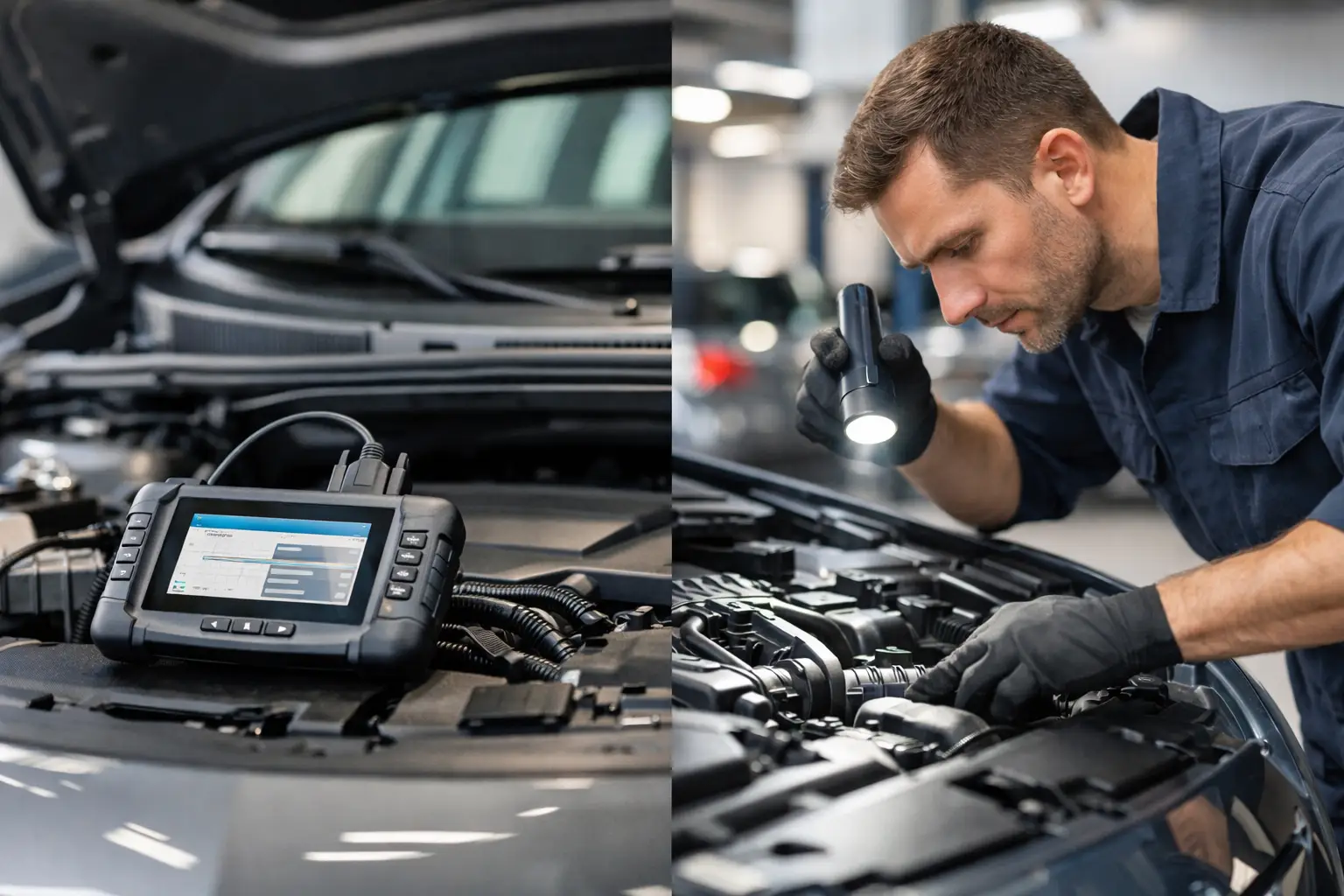
A diagnostic scan connects specialist equipment to your vehicle and reads information stored by its electronic control units. This may include fault codes, live readings, freeze-frame data and service information. On a VAG vehicle, a scan can also show which module has reported an issue, whether the fault is current or intermittent, and how often it has occurred.
For straightforward concerns, that information can be enough to point the repair in the right direction. A sensor circuit with an obvious wiring fault, for example, may be identified quickly. A service reminder can be reset after the correct maintenance has been completed. A scan is also an essential part of routine checks before buying a used vehicle or investigating a warning light.
The limitation is that a fault code normally describes what the control unit has noticed, not necessarily the part that has failed. A code for low boost pressure does not automatically mean the turbocharger needs replacing. It could relate to a split hose, vacuum control issue, sticking actuator, air leak, sensor reading or another condition affecting the system.
Diagnostic scan vs fault finding: the practical difference
Fault finding is the work carried out after the scan. It combines the vehicle data with a technician’s knowledge, inspection and measured testing to identify the root cause.
That may involve checking wiring integrity, power and earth supplies, comparing live data against expected values, pressure testing a system, inspecting mechanical components or carrying out guided manufacturer test plans. On an intermittent issue, it may mean road testing the vehicle under the conditions in which the fault occurs. The code gives a direction. Fault finding establishes why it happened.
This distinction matters because replacing the component named in a code can become expensive guesswork. It may clear the warning light temporarily while the original cause remains. A quality repair should include confirmation that the fault has been resolved, rather than simply deleting the stored code.
For drivers around Aldermaston, Tadley, Basingstoke, Reading and Newbury, this is especially useful when the car is needed for the daily commute, school runs or regular motorway mileage. A proper diagnosis may take longer than a quick scan, but it can prevent repeat visits, unnecessary parts costs and unreliable motoring.
Why VAG faults need brand-specific experience
Audi, Volkswagen, Škoda and SEAT models share many systems and platforms, but their faults are not always simple. The same dashboard warning can have different causes depending on engine, gearbox, mileage, maintenance history and previous repair work.
A VAG-capable workshop needs more than a generic code reader. It needs suitable diagnostic equipment, current technical understanding and experience of the common issues found across petrol, diesel, hybrid and performance models. That is particularly relevant when multiple systems communicate with each other. A low battery voltage, poor earth connection or communication fault can trigger several unrelated-looking warnings at once.
At Mechalex, diagnostic work is approached as an investigation, not a parts catalogue exercise. With more than 30 years of VAG experience, the focus is on testing the vehicle properly and explaining the findings in plain English before major work is authorised.
DSG and mechatronic concerns
If you are wondering where to get an Audi DSG service or investigate a DSG warning, choose a workshop familiar with both the servicing requirements and the diagnostic process. DSG gearboxes rely on correct fluid specifications, service intervals and accurate level-setting procedures. Skipping maintenance can contribute to shift quality concerns and long-term wear.
However, a gearbox code does not always mean the gearbox itself has failed. Fault finding may need to consider fluid condition, wiring, sensor signals, adaptation values, control-unit behaviour and the mechatronic unit. Symptoms such as delayed engagement, harsh changes, loss of drive or a flashing gear indicator deserve prompt specialist attention, especially before a small issue develops into a larger repair.
Haldex, drivetrain and performance faults
Four-wheel-drive VAG models can also require a more considered approach. A Haldex-related code may be connected to a pump, electrical supply, contamination, maintenance history or a genuine internal problem. Testing helps distinguish between these possibilities before work begins.
The same applies to reduced performance, engine management lights and poor fuel economy. Carbon build-up, boost control faults, ignition problems, intake leaks and sensor discrepancies can produce overlapping symptoms. A scan shows the electronic side of the story; fault finding checks the system as a whole.
When a scan may be enough – and when it is not
A scan-only appointment can make sense if you need the stored codes read, want an initial indication of the affected system or have a minor warning that requires assessment. It is also a sensible first step when there are no noticeable driving symptoms.
More detailed fault finding is usually the better option when a warning light returns after being cleared, the vehicle is in limp mode, there is an intermittent fault, or a previous repair has not fixed the problem. It is also appropriate where the car has poor starting, misfires, unusual noises, gearbox hesitation, loss of power or multiple warning lights.
The trade-off is simple. A diagnostic scan is often faster and lower cost at the outset. Thorough fault finding requires technician time and may involve additional tests. Yet it is usually the better value where the cause is unclear, because it reduces the risk of fitting parts that were never needed.
What good fault finding should look like
You should expect a clear process rather than a vague recommendation to replace parts. The technician should first listen to the symptoms and when they occur, then scan the vehicle and assess the relevant data. From there, physical checks and targeted tests should be used to prove or rule out likely causes.
If further investigation is needed, you should be told why. Once the cause is identified, the repair recommendation should set out what has failed, what work is required and the expected cost. After repair, the vehicle should be checked again to make sure the warning has not simply been hidden.
Using OEM or equivalent quality parts matters here too. A cheap sensor or valve can create new faults, produce inaccurate readings or fail early. Saving a little on the part can be poor value if the car has to return for more diagnosis.
A sensible next step for your VAG vehicle
If your Audi, Volkswagen, Škoda or SEAT has a warning light or a problem that no one has properly explained, do not settle for a code being cleared and hope for the best. Book a diagnostic assessment with a workshop that can scan, test and repair the vehicle in one place.
Based in Aldermaston and convenient for drivers from Tadley, Basingstoke, Reading, Newbury and surrounding areas, Mechalex offers main-dealer standard diagnostic capability without the main-dealer cost. A proper answer takes more than plugging in a machine, and it gives you a far better chance of getting back on the road with confidence.