If your Audi, Volkswagen, Škoda or SEAT feels a bit flat off the mark, hesitates under load or no longer pulls as cleanly as it used to, a fair question is: does walnut blasting improve performance? In many direct injection petrol engines, yes, it can. But the honest answer is a bit more precise than that – it restores lost performance rather than creating extra power out of nowhere.
That distinction matters, especially if you use your car every day and want to spend money where it actually makes a difference.
Does walnut blasting improve performance on VAG engines?
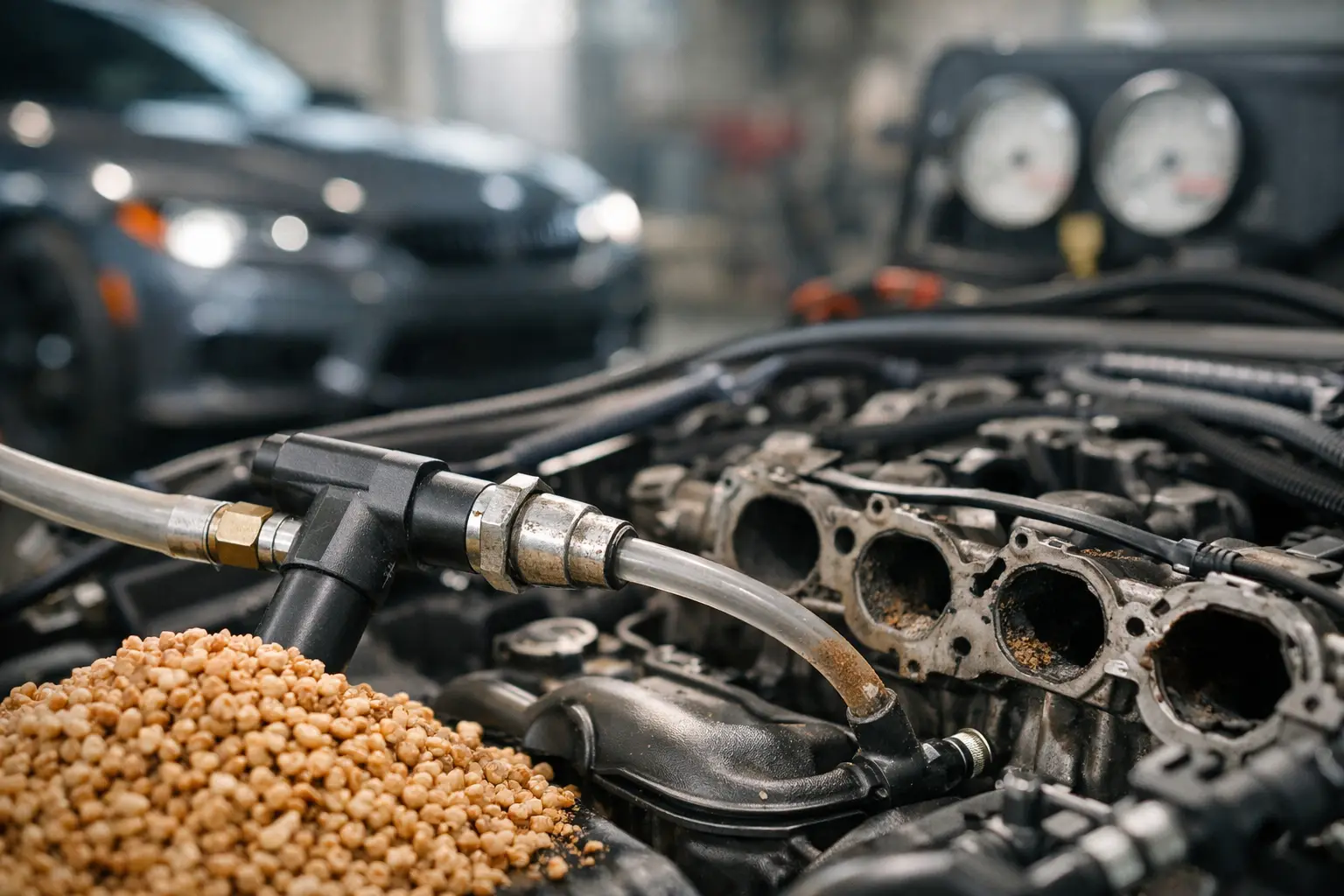
On the right engine, and at the right time, walnut blasting can make a noticeable improvement. Many VAG direct injection petrol engines are prone to carbon build-up on the inlet valves over time. Because fuel is injected directly into the combustion chamber rather than washing over the backs of the valves, oily vapours and soot can gradually stick and harden there.
As those deposits build, airflow into the engine becomes less efficient. The engine may still run, but not as cleanly or as smoothly as it should. That is where walnut blasting comes in. It removes carbon deposits from the inlet valves and ports using crushed walnut shell media, restoring airflow without damaging the metal surfaces when carried out properly.
For some drivers, the difference is subtle but worthwhile – smoother idle, sharper throttle response and better part-throttle drivability. For others, especially where carbon build-up is heavy, the improvement can feel far more obvious.
What walnut blasting actually fixes
The biggest misconception is that walnut blasting is a tuning modification. It is not. It is a cleaning process.
If the engine has lost efficiency because carbon deposits are restricting airflow, cleaning those deposits can help the engine get back closer to how it was meant to perform. That can mean improved throttle response, more consistent acceleration and, in some cases, reduced misfires or rough running. On turbocharged VAG petrol engines, where airflow and combustion quality matter a great deal, carbon build-up can have a bigger effect than many owners realise.
It can also help if the car feels reluctant at lower revs, idles unevenly or has become less refined over time without any obvious major fault. Drivers sometimes put that down to age, when in reality the engine is simply no longer breathing properly.
What it will not do is turn a standard engine into a high-performance one. If your car is healthy and not suffering from carbon build-up, walnut blasting is unlikely to produce dramatic gains.
The signs carbon build-up may be affecting performance
There is no single mileage where every car suddenly needs walnut blasting. Some engines show problems earlier, some later. Driving style, trip length, oil vapour levels and engine design all play a part.
Common signs include rough idle, hesitation on acceleration, reduced fuel economy, uneven power delivery and fault codes relating to misfires or airflow issues. Sometimes the engine management light appears. Sometimes it does not.
This is why proper diagnosis matters. A car that feels down on power could have carbon build-up, but it could also have ignition issues, boost leaks, PCV problems, injector faults or sensor-related faults. Recommending walnut blasting without checking the rest of the system is not good workshop practice.
For local owners around Aldermaston, Tadley, Reading, Basingstoke and Newbury, that is often the real value of using a VAG specialist rather than guessing. The engine needs to be assessed properly so you fix the cause, not just chase symptoms.
How much performance improvement should you expect?
This is where the answer becomes: it depends.
If the valves are heavily coked up, the improvement can be very noticeable. The engine may idle more smoothly, pick up more cleanly and feel more eager through the mid-range. If the carbon was severe enough to cause misfires or airflow restriction, the car can feel transformed simply because it is back to operating as intended.
If the deposits are moderate, the gains are usually more about refinement and consistency than outright speed. The car may feel sharper and smoother rather than significantly quicker.
If there is little carbon build-up to begin with, the effect may be minimal. That is why it should be treated as a condition-based service, not something to sell to every owner regardless of need.
For tuned or performance-oriented cars, airflow matters even more. If a remapped engine is being held back by dirty inlet valves, walnut blasting can help it perform more consistently. Even then, it is still a restoration measure, not a substitute for proper tuning or maintenance.
Does walnut blasting improve performance enough to be worth it?
For many owners, yes – if the symptoms and inspection findings support it.
The cost has to be weighed against the condition of the car and what you are trying to achieve. If you are dealing with rough running, hesitation or a general sense that the engine is not as crisp as it used to be, walnut blasting can offer good value because it addresses a genuine restriction.
If you are chasing more power on a healthy engine with no signs of carbon-related issues, your money may be better spent elsewhere. Routine servicing, spark plugs, coils, correct oil specification, intake system checks and proper diagnostics can all matter just as much.
That is especially true on older vehicles where several smaller issues can add up. Carbon cleaning may help, but it may not be the only thing the car needs.
When walnut blasting makes the most sense
It tends to make the most sense on direct injection petrol engines with known carbon build-up tendencies, particularly once mileage climbs and drivability starts to deteriorate. It is also worth considering when inspection confirms visible deposits, or when a vehicle is being prepared for other performance work and you want a solid baseline.
Owners who mainly do short journeys often see the benefit sooner. Stop-start driving, repeated cold starts and low-load use can all contribute to deposit formation. By contrast, a car that regularly does longer runs may still build carbon, but perhaps more slowly.
There is also a preventative argument, although that should be approached sensibly. Cleaning before symptoms become severe can help maintain how the engine performs, but there is little point doing it too early without evidence it is needed.
Why proper technique matters
Walnut blasting is not just a case of firing media into the intake and hoping for the best. The intake system needs to be stripped carefully, each cylinder positioned correctly, deposits removed thoroughly and the area cleaned properly afterwards.
This matters for both results and reliability. Incomplete cleaning means the restriction remains. Poor preparation or rushed work risks contamination and avoidable problems. On VAG engines, familiarity with the platform also helps because technicians know what related issues to check while access is available.
That is one reason owners often come to specialists such as Mechalex for this type of work. Experience with Audi, VW, Škoda and SEAT engines makes a difference when you are dealing with carbon-related drivability complaints rather than just ticking off a menu item.
Walnut blasting vs additives and other carbon cleaning methods
Fuel additives have their place in some maintenance routines, but they do not solve the same problem on direct injection engines. Since the fuel does not pass over the inlet valves, an additive in the tank is not going to remove hardened deposits from those surfaces in the way many drivers hope.
Chemical intake cleaning methods can sometimes help with light contamination, but they are generally less effective once build-up is heavy. Walnut blasting remains one of the most effective workshop methods because it physically removes the deposits rather than trying to soften them indirectly.
That does not mean every engine needs the most intensive approach. Again, it comes back to diagnosis and condition.
The honest answer to does walnut blasting improve performance
Yes, walnut blasting can improve performance – when carbon build-up is the reason performance has dropped. It is best thought of as a corrective service that restores airflow, drivability and engine response, rather than a bolt-on upgrade.
For VAG owners, that makes it especially worthwhile when the car feels sluggish, uneven or less refined than it should, and when inspection confirms the inlet side is contaminated. In those cases, the improvement can be more than just measurable on paper. It can make the car more enjoyable and more dependable to live with every day.
If you suspect your engine is not performing as it should, the best starting point is not to assume. Get it checked properly, understand what the engine is telling you, and then spend money on the work that will genuinely put it right.