If your Audi quattro feels a little less sure-footed in wet weather, or the rear axle seems slow to join in when traction drops, the Haldex unit is one of the first places worth looking. The Haldex service interval for Audi quattro is not something to leave to chance, because this system relies on clean fluid and proper maintenance to keep the four-wheel-drive system working as it should.
For many Audi models fitted with a Haldex-type quattro system, a sensible benchmark is every 3 years or 20,000 to 40,000 miles, depending on model, generation and use. That said, the real-world answer is not always identical to the line in a handbook. Driving style, traffic, towing, short trips and performance use can all shorten the safe interval.
What the Haldex system actually does
Not every quattro system is the same. On many transverse-engined Audi models such as the A3, TT, Q3 and some S and RS derivatives, the car uses a Haldex-controlled all-wheel-drive setup rather than the traditional permanent quattro arrangement found on some longitudinal models.
In simple terms, the Haldex coupling manages how drive is sent to the rear axle when conditions demand it. It uses fluid pressure, an internal pump and electronic control to engage the rear wheels quickly when slip is detected or predicted. When the fluid is contaminated or the filter and pickup become restricted, the system can respond poorly or stop working properly altogether.
That is why regular servicing matters. This is not just a fluid refresh for the sake of it. It is preventative maintenance for a system that is expensive to repair once wear and contamination have been allowed to build up.
Haldex service interval for Audi quattro – what should you follow?
The safest answer is to follow the correct interval for your exact Audi model and Haldex generation, then adjust for how the car is actually used. On paper, some owners are told the interval is around 3 years, while others work to a mileage schedule. In practice, many specialists prefer not to stretch these systems too far.
A good working rule for many Audi quattro models with Haldex is servicing every 20,000 miles if the car sees harder use, and no later than 40,000 miles on lighter use if everything is operating normally. If the vehicle is tuned, used enthusiastically or spends its life on short stop-start journeys, earlier servicing is sensible rather than excessive.
This matters because Haldex fluid degrades over time and contamination settles where the pump draws from. On some generations, the pump strainer can become clogged even if there is no obvious fault code yet. By the time the driver notices a traction issue, the unit may already be struggling.
Why owners get caught out
Part of the confusion comes from the quattro badge itself. Audi uses the same name across different four-wheel-drive systems, so owners understandably assume one service rule covers all of them. It does not.
A longitudinal quattro setup with a centre differential does not follow the same maintenance pattern as a Haldex-equipped transverse car. Add in different Haldex generations across the Audi range, and it becomes easy to see why generic advice can be misleading.
Another issue is that some cars do not show obvious symptoms early on. The system can become less effective gradually, especially in normal road driving where the loss of rear engagement is subtle. Owners may only discover a problem when the weather turns, when an MOT advisory leads to further inspection, or when a fault is picked up during diagnostics.
Signs your Audi may need Haldex servicing sooner
A fixed interval is helpful, but condition still matters. If your Audi is showing signs that the rear axle is not being engaged correctly, it is worth having the system checked rather than waiting for the next scheduled service.
Typical warning signs include hesitant traction on slippery roads, fault messages relating to drivetrain or stability systems, unusual noises from the rear differential area, or a feeling that the car is behaving more like front-wheel drive than it used to. Some owners also notice wheelspin more easily when pulling away briskly in the wet.
Not every one of these symptoms means the Haldex unit itself has failed. Sometimes the issue lies with the pump, pressure generation, wiring, control faults or old fluid restricting flow. That is exactly why proper VAG diagnostics matter. Replacing parts without checking live data and system behaviour can become expensive quickly.
What happens during a proper Haldex service?
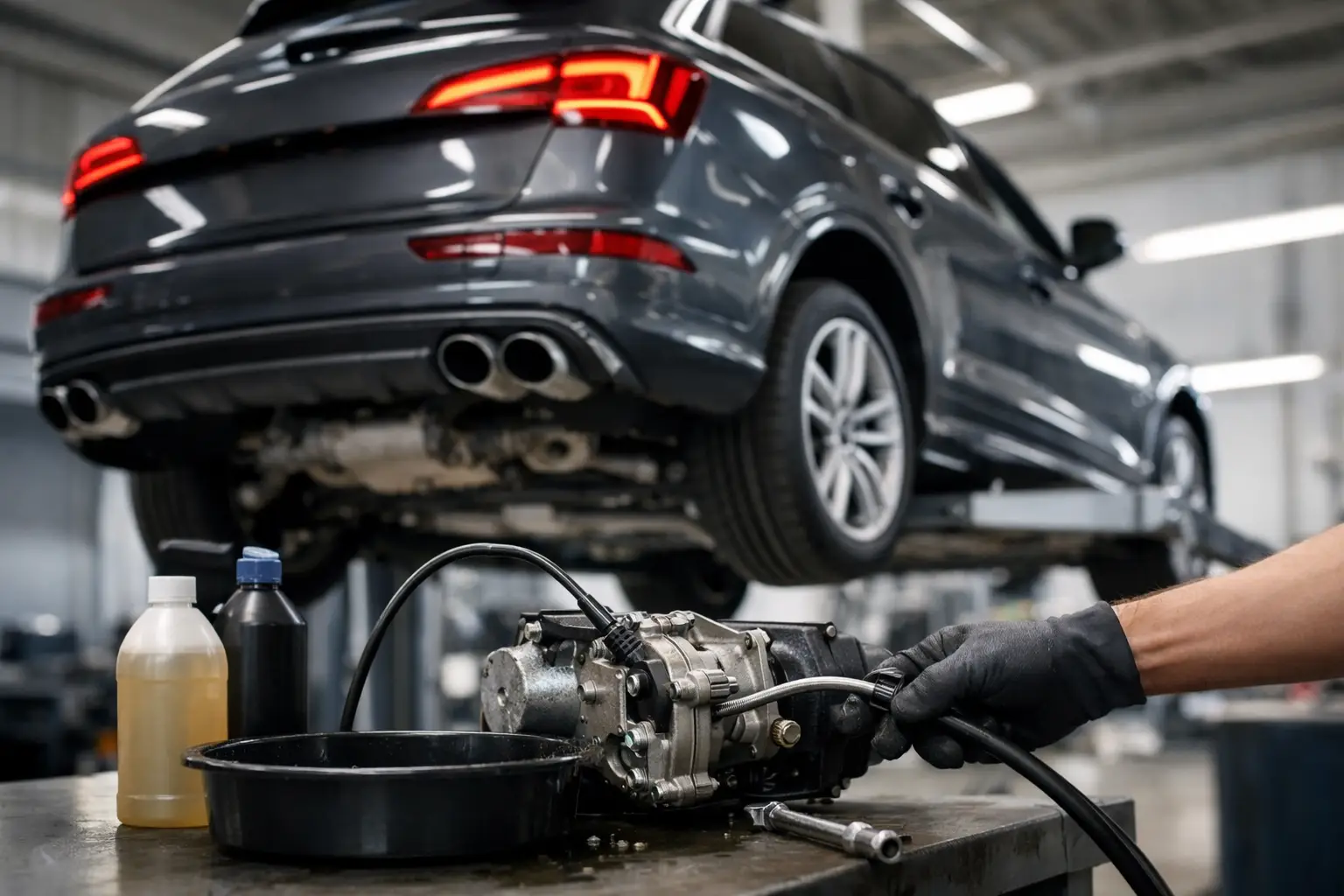
A proper service is more than draining and refilling fluid. The exact procedure depends on the generation fitted to the car, but the aim is the same – remove contaminated fluid, inspect the system properly and make sure the pump side of the unit is not being starved by debris.
On many units, the pump is removed and the pickup or strainer area is cleaned as part of the job. Fresh correct-specification fluid is then fitted, and the system is checked for leaks, operation and any stored faults. If there are signs of pump weakness or a deeper mechanical issue, that should be identified before the car is handed back.
This is where specialist experience makes a difference. A workshop familiar with VAG four-wheel-drive systems will know the common faults, the variations between generations and the difference between routine servicing and a unit that is already heading towards repair territory.
Why skipping the interval is a false economy
Haldex servicing is one of those jobs that can look optional right up until the bill is not. A neglected system may end up needing pump replacement, further diagnostic work or, in the worst cases, more extensive differential or coupling repairs.
Compared with that, routine fluid service is straightforward maintenance. It protects the parts that make the system work and helps preserve the sure-footed feel Audi owners expect from quattro. For daily drivers around Reading, Basingstoke or Newbury, that peace of mind is not just about spirited driving. It is about dependable traction on wet roundabouts, frosty mornings and long motorway runs in poor weather.
There is also a resale angle. A documented maintenance history is always helpful on specialist systems. Buyers are increasingly aware that DSG and Haldex servicing are not jobs to ignore on VAG cars, and evidence that the work has been done properly can make a used car easier to trust.
It depends on how the car is driven
This is one area where mileage alone does not tell the full story. A lightly used TT covering motorway miles will not stress its Haldex system in the same way as an S3 doing repeated short trips, quick launches and winter commuting on poor roads.
Towing, fast-road driving and performance upgrades all increase the case for shorter service intervals. Even without hard use, age matters because fluid still deteriorates over time. A low-mileage car that has not had the Haldex serviced for years is not automatically in better shape than a regularly maintained higher-mileage example.
That is why a workshop should look at the whole picture – model, year, service history, symptoms and use – rather than quoting one blanket answer.
Choosing the right workshop for Haldex work
Audi owners often assume this is a main dealer-only job, but the real requirement is brand-specific knowledge, correct procedures and the right diagnostic equipment. Haldex systems sit in that category of work where experience with VAG drivetrains makes the difference between proper maintenance and guesswork.
If a workshop regularly handles Audi, Volkswagen, Škoda and SEAT models, understands common Haldex faults and uses OEM or equivalent quality parts and fluids, that is usually a far better indicator than a dealer logo on the wall. Specialist independent garages can often offer the same level of technical care with a more practical, value-led approach.
For owners in the Aldermaston and Tadley area, that means you do not have to travel far or pay main dealer prices to have the job done properly. Mechalex sees these systems as part of everyday VAG specialist work, not an unusual extra.
When to book it
If you do not know when your Haldex was last serviced, that is usually the moment to ask the question. A missing history entry is reason enough to inspect it, especially on a used Audi where previous maintenance may not have been as complete as it should have been.
As a rule, service it by time as well as mileage, bring the interval forward if the car is tuned or worked hard, and do not ignore early signs that the four-wheel-drive system is not behaving quite right. A Haldex-equipped Audi should feel composed and capable. If it does not, there is usually a reason.
The best time to deal with Haldex maintenance is before it becomes a fault, because four-wheel-drive confidence is much cheaper to preserve than it is to rebuild.