A VW arrives with the gearbox stuck in limp mode, the dash lit up, and the driver already braced for a large bill. That is usually how a case study VW DSG limp mode fault begins – not with a failed gearbox, but with uncertainty. The problem for owners is that DSG faults can feel dramatic even when the root cause is relatively contained. The problem for workshops is that guessing gets expensive very quickly.
For Volkswagen, Audi, Škoda and SEAT owners, limp mode is one of those faults that immediately raises fears about mechatronic failure or a full gearbox replacement. Sometimes that concern is justified. Quite often, it is not. A proper diagnosis matters because the same symptom can come from worn internal components, fluid issues, sensor faults, wiring problems, low system pressure or software-related behaviour. If you treat every limp mode event as a gearbox rebuild, you will spend far more than necessary.
Case study VW DSG limp mode – the complaint
In this example, the vehicle came in with an intermittent loss of normal gear selection. The driver reported a harsh engagement from rest, hesitation when pulling away, and then the gearbox defaulting to a restricted operating mode. On some journeys the car would behave normally for miles. On others, it would enter limp mode within minutes of driving. Restarting the car sometimes restored operation temporarily, which is a common detail with electronic or hydraulic control faults.
There had already been some online research by the owner, and the usual worst-case answers had appeared – failed gearbox, failed clutch pack, replacement mechatronic unit. That is understandable, because DSG issues are widely discussed and the internet rarely starts with the cheapest possibility. But intermittent faults are exactly where structured testing earns its keep.
The first stage was to confirm the symptom properly rather than relying only on the customer description. A road test, live data review and full fault-code scan built a much clearer picture. The gearbox control unit had logged faults relating to pressure regulation and implausible gearbox operation under load. Freeze-frame data showed the fault occurring once fluid temperature had risen and the vehicle had gone through repeated stop-start traffic conditions.
Why limp mode happens on a DSG
Limp mode is not a fault in itself. It is the gearbox control system protecting the transmission when operating values move outside expected limits. In plain terms, the car is limiting function to avoid making a bad situation worse.
On a DSG, that can happen for several reasons. The mechatronic unit is a frequent suspect because it manages hydraulic pressure and gear selection. If it cannot control pressure correctly, the gearbox may not engage or shift as intended. Clutch wear can also cause adaptation values to drift outside tolerance. Then there are more routine possibilities such as incorrect or degraded transmission fluid, poor previous repair work, electrical connection issues or internal sensor problems.
This is why blanket answers are unhelpful. Two cars with identical limp mode symptoms can need very different repairs. One may need a fluid service and adaptation procedure. Another may need mechatronic repair. Another may prove to have internal gearbox wear that only becomes obvious after the control side has been tested properly.
The diagnostic process that matters
On this vehicle, the scan data alone was not enough to justify replacing parts. Fault codes point you in a direction, but they do not always tell you why the code set in the first place. A pressure-control code, for example, may indicate a failing mechatronic unit, but it can also be triggered by fluid condition, contamination or mechanical drag elsewhere in the transmission.
The next step was to check service history and confirm whether the gearbox had been maintained at the correct interval. That matters more than many owners realise. Some DSG variants are especially sensitive to fluid condition and correct servicing procedures. In this case, the history was incomplete, and there was reason to question whether the previous maintenance had been carried out to the right standard.
Fluid condition was then inspected, and adaptation values were reviewed alongside measured operating data. This is where experience with VAG vehicles helps. Looking at numbers is easy. Knowing which values are genuinely out of character for that gearbox, in that temperature range, under that load, is where specialist diagnosis pays off.
The results suggested the gearbox was struggling to maintain stable hydraulic control once warm. However, there was not enough evidence yet to condemn the entire transmission. The clutch values were not pointing strongly towards severe mechanical wear, and the pattern of failure remained more consistent with a control-side issue than a complete gearbox failure.
What the fault turned out to be
In this case study VW DSG limp mode fault, the underlying issue was traced to the mechatronic side of the transmission rather than the gearbox as a whole. The unit was no longer regulating pressure consistently, particularly once operating temperature increased. That inconsistency was enough to trigger protective mode and the harsh, hesitant behaviour the driver had noticed.
This outcome matters because it changed the scale of repair. The owner had been preparing mentally for a replacement gearbox. The actual fix was targeted and based on evidence, not assumption. Even when a mechatronic repair is not a small job, it is still very different from replacing an entire DSG unit unnecessarily.
It is also worth saying that not every mechatronic-related fault means the same remedy. Sometimes the sensible route is repair. Sometimes replacement is the better long-term option. It depends on the fault pattern, the specific gearbox, parts availability and the condition of the rest of the transmission. The right answer is the one supported by testing, not the one that sounds most dramatic.
What owners often miss with DSG problems
One of the biggest mistakes is continuing to drive for weeks after limp mode first appears, especially if a restart seems to clear it. Temporary recovery does not mean the fault has gone away. It usually means the control unit has reset and is waiting to see the problem again. Repeated operation in that state can increase wear, create additional faults and make diagnosis less straightforward.
Another issue is poor-quality repair history. DSG gearboxes do not respond well to shortcuts. Incorrect fluid specification, inaccurate fill procedures, missed service intervals or rushed adaptation work can all create problems that look bigger than they started. The gearbox is a sophisticated unit, but that does not mean it is fragile. It does mean it needs the correct process.
For owners around Aldermaston, Tadley, Basingstoke, Reading and Newbury who rely on their car every day, that distinction matters. A daily driver with an intermittent DSG fault needs a proper answer quickly. You do not want a generic diagnosis, and you do not want parts replaced one by one in hope.
What a proper DSG diagnosis should include
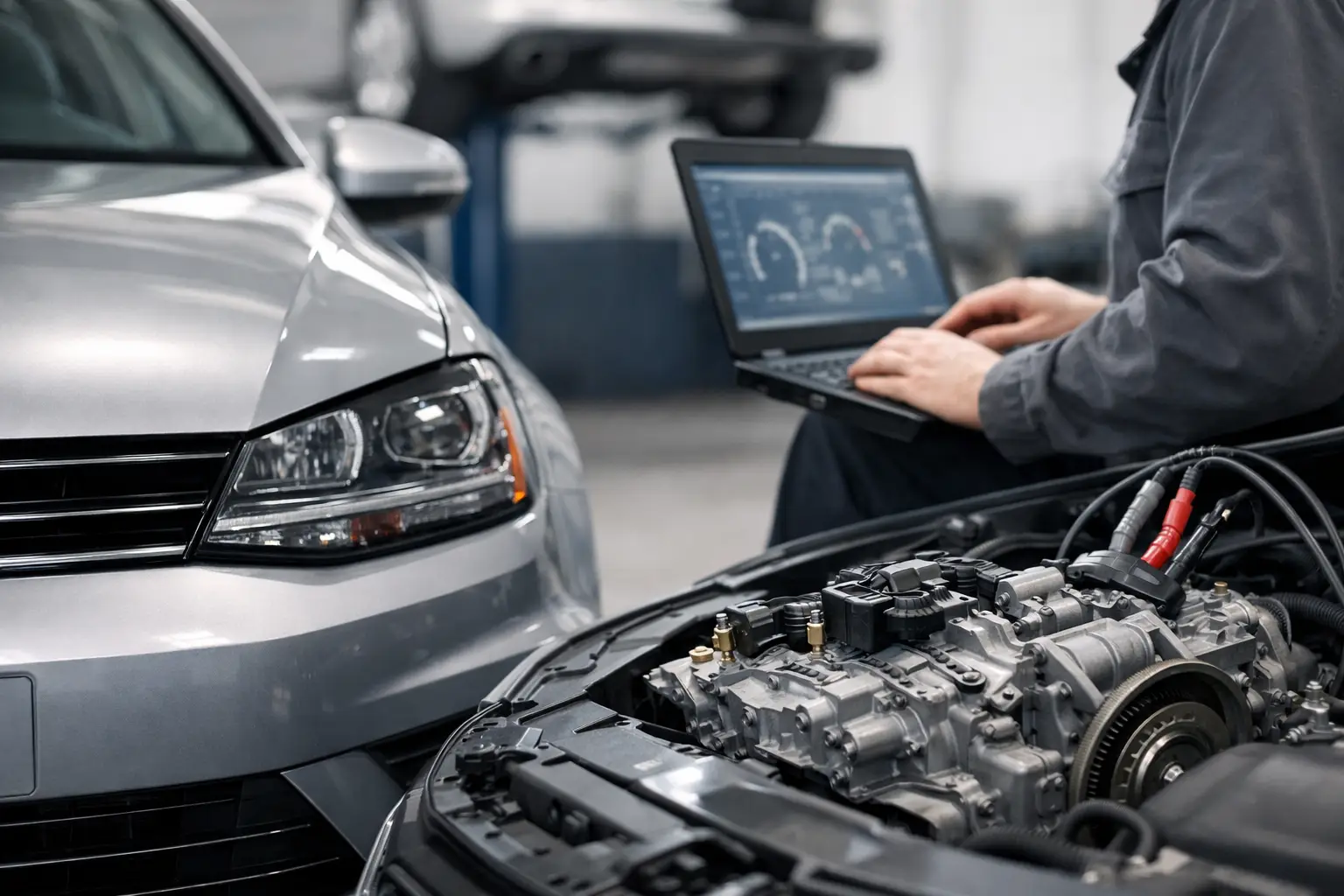
A worthwhile diagnosis should combine a full fault-code scan, road testing, live data assessment, service-history review and inspection of fluid condition where relevant. It should also take account of the exact gearbox type fitted to the vehicle, because common faults vary across the VAG range.
It should not jump straight from limp mode to gearbox replacement. Equally, it should not downplay the issue with a basic reset and send the car back out if the root cause has not been identified. Good diagnosis sits in the middle – cautious enough to avoid waste, thorough enough to avoid repeat failure.
For a specialist workshop, this is where modern diagnostic equipment and VAG-specific experience make a real difference. There is a big gap between reading gearbox faults and understanding gearbox faults. If you know the platform, the service history patterns and the way these units behave in real use, you can narrow the problem far more efficiently.
The real lesson from this VW DSG limp mode case study
The lesson is not that limp mode is harmless, because it is not. The lesson is that limp mode is a symptom, and symptoms need proving before parts are ordered. Owners often come in fearing the most expensive outcome. Sometimes the diagnosis does confirm a significant repair. But just as often, a methodical process prevents the wrong repair from happening first.
That is especially true with VAG vehicles, where the technology is excellent but the margin for poor diagnosis is small. A DSG fault can sit in the overlap between electronics, hydraulics, software and mechanical wear. If you only look at one side of that picture, you can miss the real cause.
If your Volkswagen, Audi, Škoda or SEAT has started showing DSG warning signs – harsh take-up, delayed engagement, flashing indicators on the selector display or intermittent limp mode – the sensible next step is not to assume the worst. It is to have it checked properly by people who understand how these gearboxes fail, how they are tested and what a good repair actually looks like.
A gearbox fault always feels urgent when it happens on the school run, the commute or a weekend trip. The good news is that accurate diagnosis usually brings the situation back down to earth, and that is the point where sensible decisions can be made.