A previously sharp Audi that has become hesitant in traffic, flat under acceleration or less economical than usual may not need a major engine repair. For many direct-injection petrol models, Audi engine carbon cleaning is a targeted way to remove deposits from the inlet valves and restore the airflow the engine was designed to receive. The key is confirming that carbon build-up is actually the cause before authorising the work.
At Mechalex, we diagnose the fault first and recommend cleaning only when it is the sensible repair. That means VAG-specific knowledge, modern diagnostic equipment and an approach built around fixing the cause rather than selling a generic treatment.
Why carbon builds up in Audi petrol engines
Many modern Audi petrol engines use direct injection, including popular TFSI units. Unlike older port-injection engines, fuel is injected directly into the combustion chamber rather than over the back of the inlet valves. That improves control and efficiency, but it also means petrol no longer helps wash the valves clean.
Over time, oil vapour from the crankcase ventilation system and residue from exhaust-gas recirculation can adhere to the inlet valves. Heat turns this into hard carbon deposits. Short journeys, repeated cold starts and stop-start commuting can make the problem more likely, although a car used mainly on longer motorway runs can still develop build-up.
This is not automatically a sign that an Audi has been poorly maintained. It is a known characteristic of many direct-injection petrol engines. Good servicing, correct oil specification and prompt attention to faults all help, but they cannot always prevent deposits indefinitely.
Signs your Audi may need carbon cleaning
Carbon deposits restrict and disturb incoming air. When they become significant, the engine may struggle to breathe consistently, especially at low and mid-range revs where most everyday driving happens.
Owners around Tadley, Basingstoke, Reading, Newbury and Aldermaston commonly book an inspection after noticing a rougher idle, an intermittent misfire, reduced throttle response or a loss of the performance the car once had. Some cars also return poorer fuel economy or trigger an engine management light. On performance models, the change may be most obvious when the engine feels unwilling to pull cleanly through the rev range.
Those symptoms do not prove carbon is the issue. Worn spark plugs, ignition coils, vacuum leaks, injector faults, timing concerns and boost-system problems can all feel similar. That is why a code read alone is not enough. A proper assessment should consider live diagnostic data, service history and the engine’s behaviour, with further inspection where appropriate.
If a misfire warning is flashing, or the engine is running severely rough, avoid continuing to drive it unnecessarily. Unburnt fuel can damage the catalytic converter, and the underlying fault needs prompt diagnosis.
How Audi engine carbon cleaning works
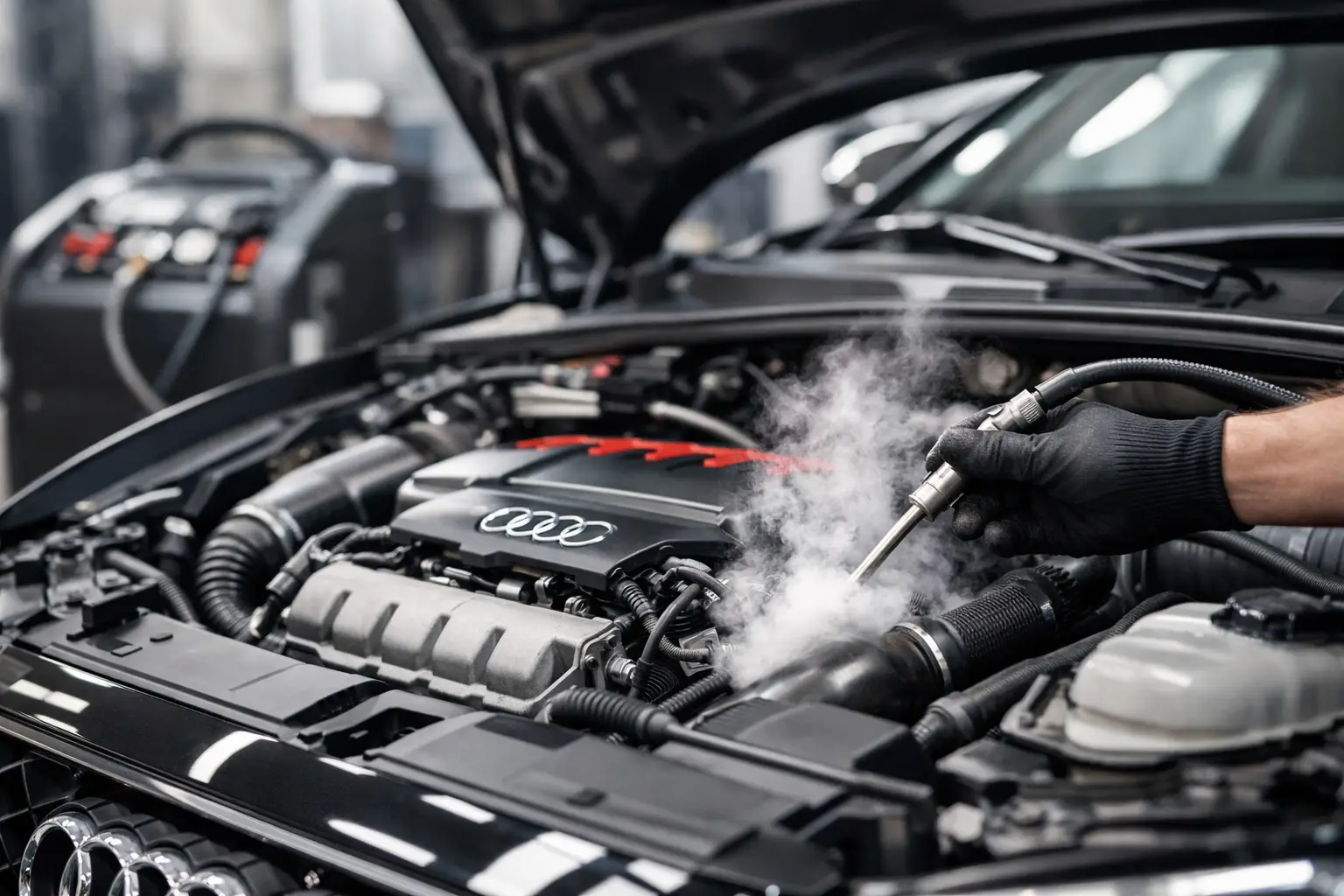
For suitable petrol engines, walnut blasting is the preferred workshop method for removing stubborn deposits from inlet valves and ports. With the inlet manifold removed, a controlled stream of finely crushed walnut shell media is used to lift carbon without damaging the metal surfaces. The valves are cleaned in stages, with the ports carefully managed so debris is not allowed into the cylinder.
It is a skilled, labour-intensive job rather than a bottle of additive poured into the fuel tank. Fuel additives can have a place in wider maintenance, particularly for injectors and fuel-system cleanliness, but they cannot properly clean the back of inlet valves on a direct-injection engine because the fuel does not pass over them.
The process starts with inspecting the car and confirming suitability. The intake system is dismantled carefully, the valves are cleaned methodically, and the engine is reassembled using the appropriate seals and procedures. Once complete, the car should be checked for correct running and any stored faults addressed.
The result depends on the level of build-up and whether carbon was responsible for the symptoms. A heavily restricted engine can feel noticeably smoother and more responsive. If the original problem was a failing coil pack or a boost leak, cleaning alone will not be the answer. Honest diagnosis protects both the car and your budget.
Is walnut blasting safe for an Audi?
When it is carried out by an experienced technician using the correct equipment and procedure, walnut blasting is an established and effective cleaning method. The important part is preparation and control, not simply the blasting itself. A rushed job risks incomplete cleaning, leaks after reassembly or contamination in the wrong place.
Mechalex works on Audi and the wider Volkswagen Audi Group range every day, using dealer-level diagnostics alongside practical workshop experience built over more than 30 years. OEM or equivalent-quality parts are used where replacement seals or related service items are required.
Which Audi engines benefit most?
Direct-injection petrol engines are the usual candidates. This includes many TFSI engines fitted across Audi A1, A3, A4, A5, A6, Q3, Q5 and TT ranges, as well as higher-performance S and RS models. The exact engine code, mileage, use pattern and symptoms matter more than the badge on the tailgate.
There is no single mileage at which every Audi needs cleaning. Some engines show meaningful deposits around 40,000 to 60,000 miles, while others run well considerably longer. Cars driven mostly on short local trips may need attention earlier than those regularly brought fully up to temperature on longer journeys.
Diesel Audis are a separate case. They can suffer from intake, EGR and emissions-system contamination, but the diagnosis and repair route may differ from petrol inlet-valve walnut blasting. A diesel with reduced power, warning lights or regeneration issues needs a proper assessment of the EGR system, DPF, sensors, boost control and intake path rather than a one-size-fits-all cleaning recommendation.
Carbon cleaning, servicing and performance work
Carbon cleaning works well as part of a sensible maintenance plan. If the inlet manifold is already being removed for related repairs, it can be cost-effective to inspect the valves at the same time. Likewise, a car being prepared for ECU calibration or performance work should be mechanically healthy first. Tuning an engine that is struggling for airflow is not good practice.
For DSG-equipped Audis, it is also worth keeping the transmission service schedule separate in mind. A DSG service protects the gearbox and its clutches or hydraulic systems; carbon cleaning addresses engine breathing. Both can transform how a car feels, but neither replaces the other. The same applies to Haldex servicing on quattro models, where correct maintenance supports the four-wheel-drive system rather than the engine itself.
A workshop familiar with VAG platforms can look at the whole vehicle rather than treating each symptom in isolation. That is particularly useful on older Audis, where several overdue maintenance items can combine to make a car feel tired.
A practical local option for Audi owners
For drivers in Aldermaston and Tadley, Mechalex offers a specialist alternative to main-dealer pricing without compromising on diagnostic capability or workmanship. It is also a convenient choice for Audi owners travelling from Basingstoke, Reading, Newbury and surrounding villages who want a workshop that understands VAG engine systems beyond routine servicing.
Before booking carbon cleaning, ask for a diagnosis that explains what has been found, why the work is recommended and what outcome is realistic for your car. A clear estimate should account for access, cleaning, reassembly and any parts that may sensibly be replaced while the inlet system is apart. Courtesy-car availability can also make a planned visit easier where the job needs the vehicle for the day.
If your Audi has lost the crisp response you expect, arrange an assessment rather than guessing. The right repair may be walnut blasting, or it may be something simpler – either way, a careful diagnosis is the best place to start.